

If you missed yesterday’s episode of The Barometer Report, you can watch the replay here.
For those who still prefer the written word, here’s a cleaned-up transcript:
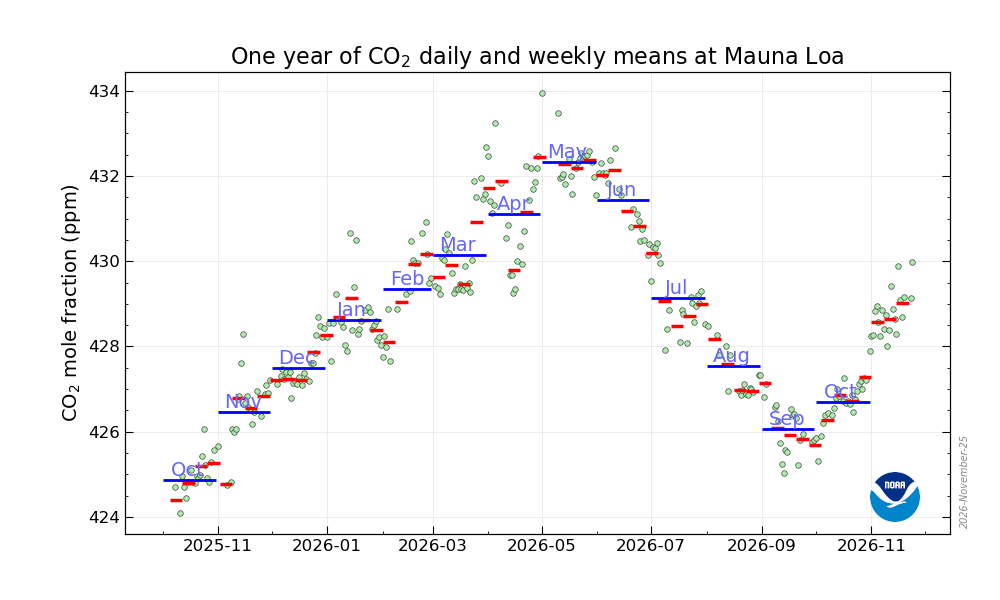
As always, we begin with a reading of the concentration of carbon dioxide in Earth’s atmosphere, courtesy of our scientists at NOAA’s Mauna Lau station.
Our latest atmospheric carbon dioxide reading from Mauna Loa is 429.98 parts per million, compared to approximately 280 parts per million before the Industrial Revolution.
On Friday, November 20, preliminary data indicated that Earth experienced its most anomalously hot day on record.
October recorded extraordinary global temperatures, with ocean temperature anomalies exceeding anything previously documented in NOAA’s monthly records.
And while all of this was happening, representatives from around the world were gathered in Antalya, Turkey, for the United Nations’ annual climate change conference, where some of the world’s largest fossil fuel producers fought against including references to fossil fuels in an international agreement on climate change.
Meanwhile, across the Pacific Ocean, what could become one of the strongest El Niño events in recorded history continues to develop.
I’ve talked and written about El Niño a lot over the last several months here at Mesoscale News. We’ve talked about its potential impacts on hurricane season, its implications for global temperatures and what scientists are seeing in the Pacific.
But this morning, I want to dedicate much of our time to explaining what El Niño actually is.
Because we tend to throw these terms around in science journalism with the assumption that everyone knows what we’re talking about.
And knowing that El Niño means warmer water in the Pacific isn’t the same as understanding why that water gets warmer, why it affects weather on the other side of the planet, or why scientists are particularly concerned about the El Niño we’re experiencing right now.
We’re also going to talk about one of the deadliest climate catastrophes in human history.
Nearly 150 years ago, an extraordinarily powerful El Niño triggered a series of famines that killed tens of millions of people across the world.
The weather was exceptional. But the scale of human suffering was, to a considerable extent, a consequence of political decisions.
And as we look at what’s happening in Sudan, in Somalia, in Gaza, in Afghanistan and elsewhere, I think there are some lessons from that catastrophe that deserve our attention.
We’ll talk about what climate change has to do with El Niño, what these extraordinary temperature records mean in the context of the Paris Agreement, and what happened at COP31.
Because the physical conditions of our planet and the political conditions under which we’re attempting to address them are becoming increasingly incompatible.
What exactly is El Niño?
The Pacific Ocean covers approximately one-third of Earth’s entire surface.
It is larger, in terms of surface area, than all of Earth’s continents combined.
I want you to keep that in mind throughout this discussion, because understanding the scale of the Pacific Ocean is fundamental to understanding how changes in that ocean can influence the climate of the entire planet.
The story of El Niño begins with fishermen along the western coast of South America.
The waters off the coast of Peru are ordinarily quite cool, considering how close they are to the equator. They’re also home to some of the most productive fisheries in the world.
But fishermen noticed that every so often, the waters off their coast would become unusually warm. The fish they depended on would become more difficult to find, and the weather would change.
Because this warming was often particularly noticeable around Christmas, they called it El Niño, a reference to the Christ child.
What those fishermen were observing was one manifestation of a much larger phenomenon occurring across thousands of miles of the Pacific Ocean.
It would take generations of scientific research, advances in atmospheric science and the development of technology capable of monitoring the open ocean for us to understand the true scale of what those fishermen had observed.
Today, we understand El Niño as one phase of a recurring relationship between the Pacific Ocean and the atmosphere above it.
When a large portion of the central and eastern tropical Pacific becomes unusually warm, and the atmosphere responds to that warming, we experience El Niño.
When that same region becomes unusually cool, and the atmosphere responds accordingly, we experience La Niña.
And when neither of those things is happening, we generally refer to those conditions as neutral.
Collectively, scientists refer to this as the El Niño–Southern Oscillation, or ENSO.
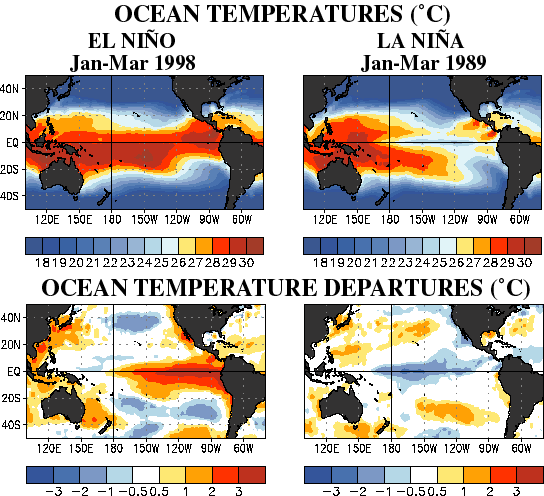
You’ll hear me use that acronym throughout today’s show. It encompasses all three of those conditions: El Niño, La Niña and neutral.
El Niño and La Niña events generally occur at intervals of two to seven years, but there is no precise schedule. We don’t necessarily go directly from El Niño into La Niña or from La Niña into El Niño.
Individual events typically last somewhere around nine months to a year, although some last considerably longer.
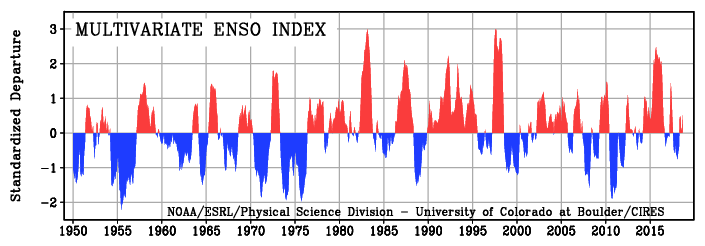
El Niño also has a tendency to develop during the Northern Hemisphere spring or summer and reach its greatest intensity around the end of the calendar year.
That’s one reason the next several months are so important.
Now, El Niño is not a storm.
It isn’t something that forms in the middle of the Pacific and travels across the ocean, like a hurricane.
It’s a change in the way a substantial portion of our planet’s ocean and atmosphere interact with one another.
And those changes can influence weather patterns virtually everywhere on Earth.
What happens in the Pacific does not stay in the Pacific.
What causes El Niño?
To understand how El Niño develops, there are three basic principles we need to understand:
Wind moves water.
Warm air tends to rise.
And the ocean stores heat.
Under normal conditions, winds near the equator blow from east to west across the Pacific Ocean. Those winds push warm surface water away from South America and toward Australia and Indonesia. As that warm water moves away from South America, colder water from deeper in the ocean rises to replace it.
That’s why the ocean can be relatively cool off the coast of Peru while being exceptionally warm around Indonesia, despite those places being at similar latitudes.
That colder water rising toward the surface is also rich in nutrients. Those nutrients support microscopic marine organisms, which support larger organisms, which eventually support extraordinarily productive fisheries.
Entire ecosystems, entire economies and entire communities depend on this process.
Scientists call the movement of that cold water toward the surface upwelling.
Now, something else is happening at the same time.
Above the warmer waters of the western Pacific, water evaporates, warm and moist air rises, clouds develop and rain falls.
That helps explain why places like Indonesia are ordinarily so wet.
Over the cooler waters of the eastern Pacific, the atmosphere behaves differently.
The ocean is influencing the atmosphere, and the atmosphere, through those winds pushing water across the Pacific, is influencing the ocean.
They’re sustaining one another.
During El Niño, that relationship begins to change.
The winds that normally push warm water toward Australia and Indonesia weaken.
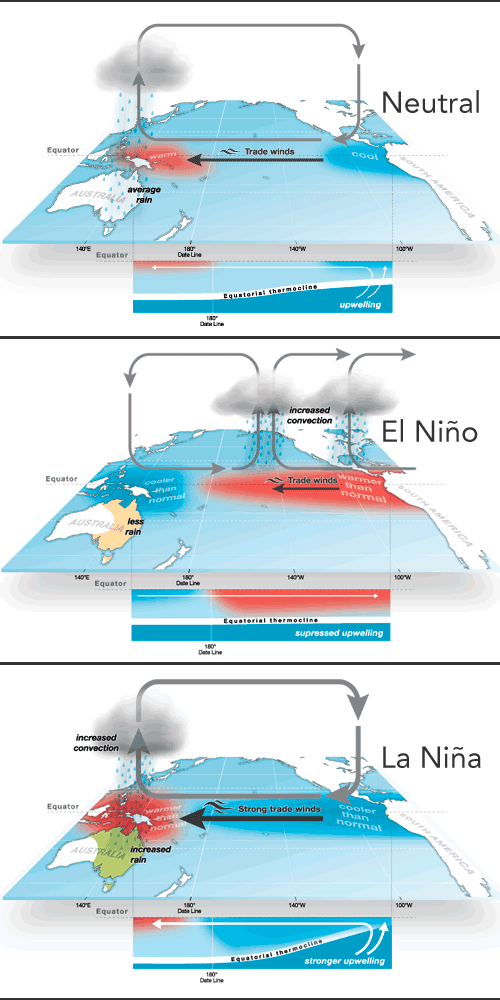
Some of the warm water that has accumulated in the western Pacific spreads eastward.
Less cold water makes it to the surface near South America.
The eastern and central Pacific get warmer.
As those waters become warmer, the atmosphere above them changes. Areas where clouds ordinarily develop and rain ordinarily falls begin to shift.
And those changes in the atmosphere can cause the winds to weaken even further.
Which allows the ocean to warm even more.
Which causes further changes in the atmosphere.
In science, we call this a positive feedback.
Positive doesn’t mean beneficial. It means the process reinforces itself.
The initial change creates conditions that allow more of that change to occur.
We talk about positive feedbacks quite often in climate science.
As ice melts in the Arctic, for example, it exposes darker ocean water. That darker water absorbs more sunlight than the ice did, contributing to additional warming, which can cause more ice to melt.
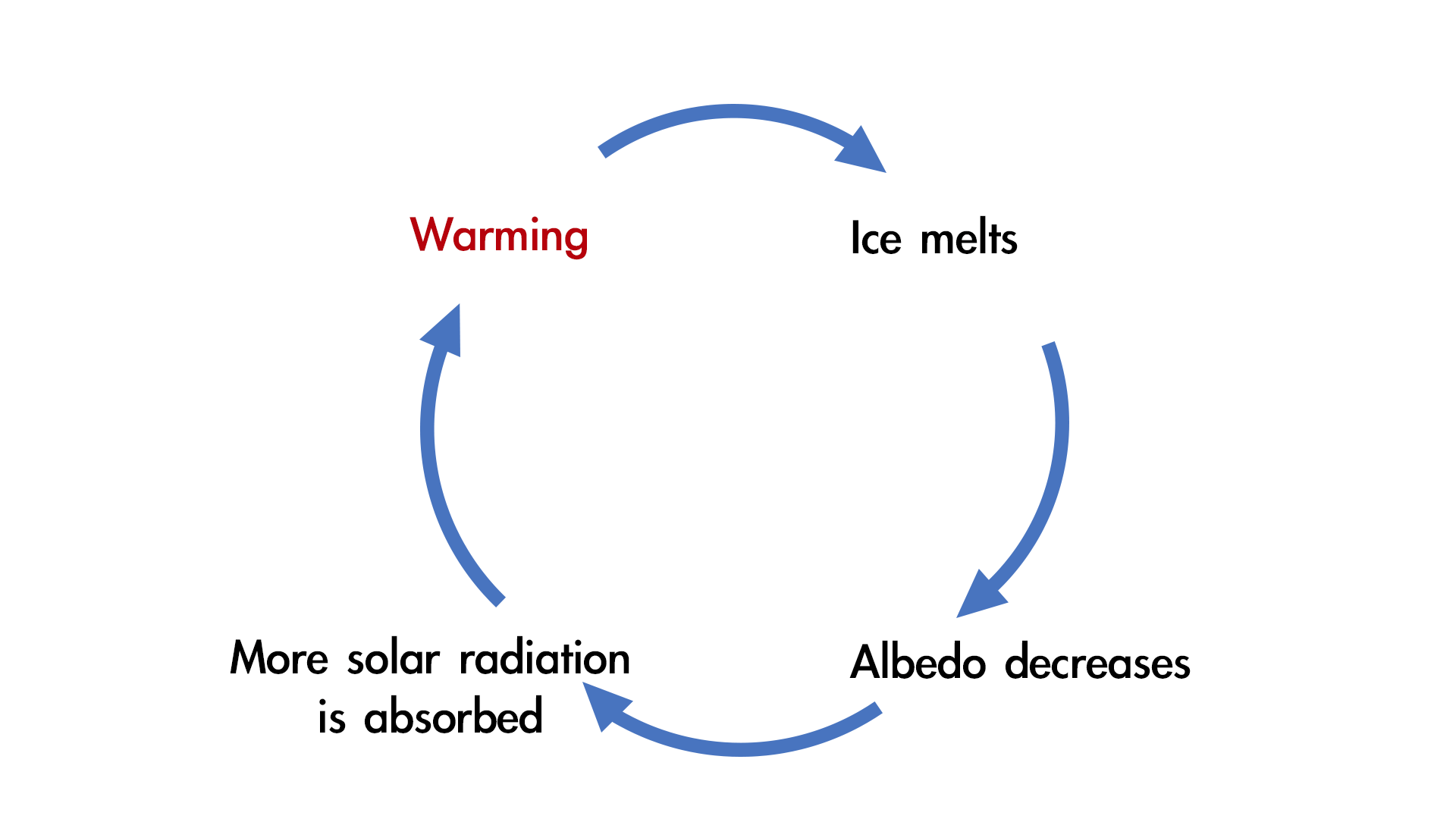
The physical process is different, but the concept is the same.
Now, there are changes happening beneath the ocean surface, changes in the atmosphere, and interactions between different weather systems that can help initiate individual El Niño events.
Some events develop much more rapidly than others. Some produce much greater warming in the eastern Pacific, while others are concentrated farther west.
There isn’t one identical sequence of events responsible for every El Niño.
And eventually, changes in the movement and distribution of heat within the ocean interrupt the process, causing El Niño to weaken.
Sometimes the system returns to conditions that are close to normal. Sometimes it shifts toward La Niña.
During La Niña, the winds that ordinarily push warm water toward Australia and Indonesia tend to become stronger than usual.
More cold water rises toward the surface of the eastern Pacific, and the temperature differences that ordinarily exist between the opposite sides of the Pacific become even more pronounced.
But the fundamental relationship remains the same.
The ocean changes the atmosphere. The atmosphere changes the ocean.
And I think this is something that gets lost in the way we report on climate change, too.
We tend to talk about ocean warming, atmospheric warming, melting ice and changing rainfall patterns as though these are separate stories.
They’re not.
They’re different manifestations of changes occurring within the same interconnected system.
8:25–8:37 | How El Niño changes weather around the world
So we’ve got warmer water in the Pacific.
Why does someone living in Michigan care about that? Or someone living in Maryland? Or Kenya? Or India?
The atmosphere is constantly moving heat around the planet.
It’s one of the reasons we have weather in the first place.
The equator receives more solar energy than the poles. Our oceans and atmosphere help redistribute that energy across the planet.
When you change where a significant amount of heat enters the atmosphere, as happens during El Niño, you can change how that heat moves around the planet.
You can change the winds that carry weather systems across continents. You can change where storms develop, where they travel and how much rain they produce.
Scientists refer to some of these relationships as teleconnections, which is essentially a way of describing how changes in one part of the climate system influence conditions somewhere far away.
And the consequences of those changes vary dramatically depending on where you live.
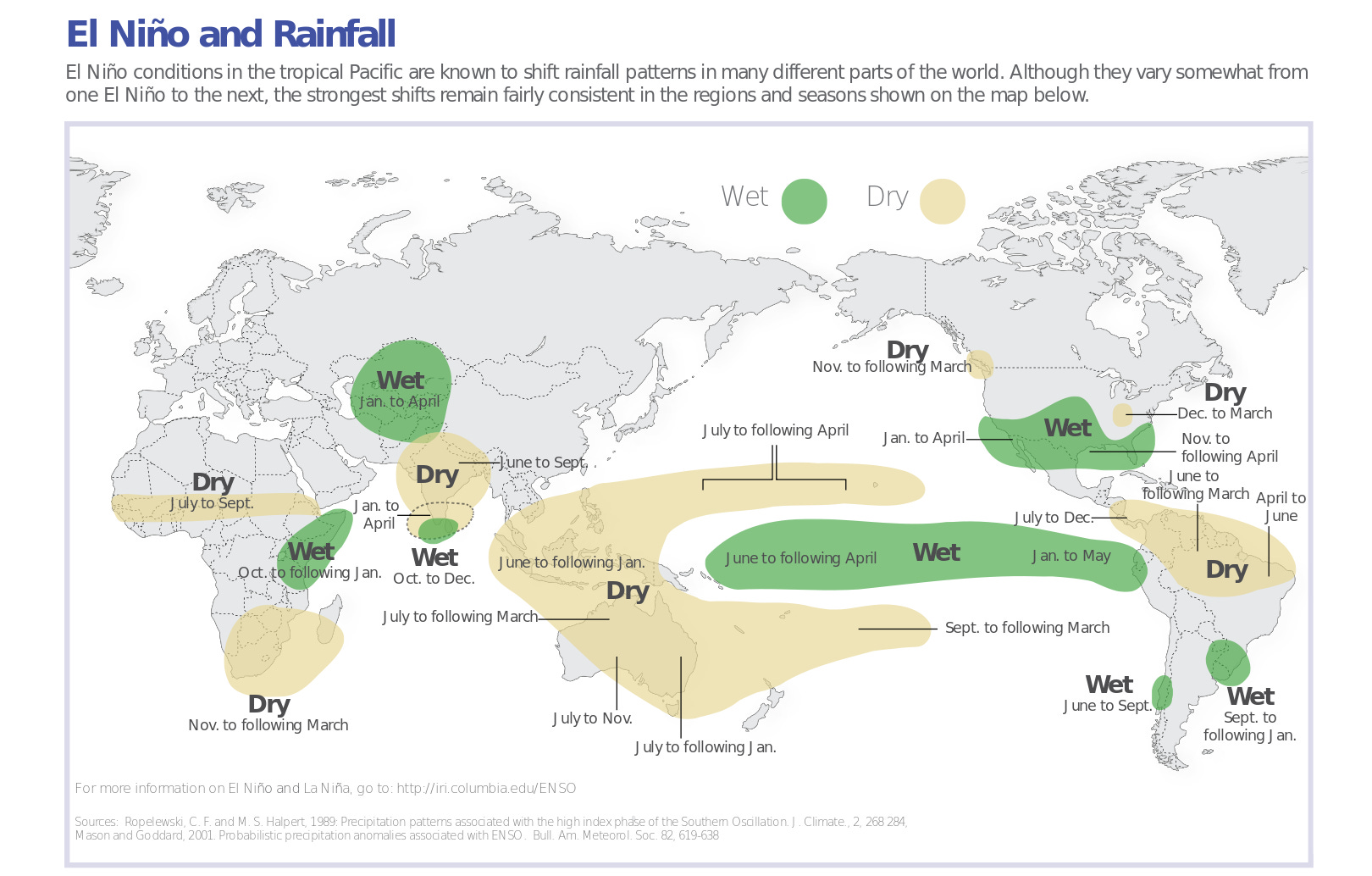
One of the things I want to emphasize throughout this discussion is that El Niño changes the probability of experiencing certain types of weather.
It does not determine every weather event that occurs during an El Niño year.
If you’re somewhere that ordinarily experiences warmer winters during El Niño and you get a snowstorm, that doesn’t mean El Niño isn’t happening.
We’re talking about changes in the overall pattern of weather over extended periods of time.
North America


Here in the United States, some of the most recognizable impacts of El Niño occur during the winter.
Across much of the southern United States, particularly along the Gulf Coast and in Florida, El Niño tends to increase the likelihood of wetter winters.
Across parts of the northern United States and Canada, it increases the likelihood of warmer winters.
Some areas in the Pacific Northwest tend to experience drier conditions.
Now, whether these changes are beneficial or detrimental depends quite a bit on the conditions that existed before El Niño developed.
If you’ve been experiencing drought for several years and your reservoirs are depleted, a wetter winter may be precisely what you need.
But if that rainfall comes down too quickly, particularly in places where we’ve developed over wetlands, paved over natural drainage areas or built communities in floodplains, it can create enormous problems.
And that’s something we talk about quite frequently here.
A natural hazard becomes a disaster when it intersects with human vulnerability.
How much rain falls is only one part of the equation.
Where we’ve built our homes, how we’ve managed our water resources, whether we’ve invested in infrastructure and whether people have the resources to recover are all part of that equation, too.
South America


Some of the most dramatic impacts occur in the region where El Niño was first identified.
When the waters off Peru and Ecuador become exceptionally warm, those communities can experience torrential rainfall and devastating flooding.
These are places where the extraordinary nature of that rainfall can be difficult to appreciate unless you understand just how dry some of these regions ordinarily are.
And while communities along the Pacific coast may be dealing with flooding, communities elsewhere in South America may be dealing with drought.
In parts of the Amazon Basin, El Niño increases the likelihood of hotter, drier conditions.
And the implications of drought in the Amazon extend well beyond South America.
The Amazon stores enormous quantities of carbon in its vegetation and soils.
When trees become stressed by heat and drought, their ability to absorb carbon dioxide from the atmosphere can decline.
When forests burn, some of the carbon they’ve accumulated over decades or centuries is released back into the atmosphere.
So a change in ocean temperatures in the Pacific can ultimately influence the amount of carbon dioxide accumulating in Earth’s atmosphere.
Australia and Southeast Asia


On the opposite side of the Pacific, parts of Australia and Indonesia tend to experience drier conditions during El Niño.
That can translate into agricultural losses, water shortages and increased wildfire risk.
Indonesia is particularly vulnerable because of the extensive peatlands that exist across parts of the country.
Peat is partially decomposed organic material that accumulates over very long periods of time.
Under normal conditions, many of these environments are wet enough that the organic material remains relatively intact.
But when those landscapes are drained or subjected to prolonged drought, that material can catch fire.
And because the fire can burn beneath the surface, it can be extraordinarily difficult to extinguish.
During the 1997 El Niño, extensive fires across Indonesia produced a regional air pollution crisis, exposing millions of people to hazardous smoke and releasing enormous quantities of carbon into the atmosphere.
El Niño contributed to the dry conditions that allowed those fires to spread.
But land clearing, agricultural development and the drainage of peatlands helped create the conditions that made those fires so destructive.
Again, we can’t separate the natural phenomenon from the human decisions that determine its consequences.
Africa
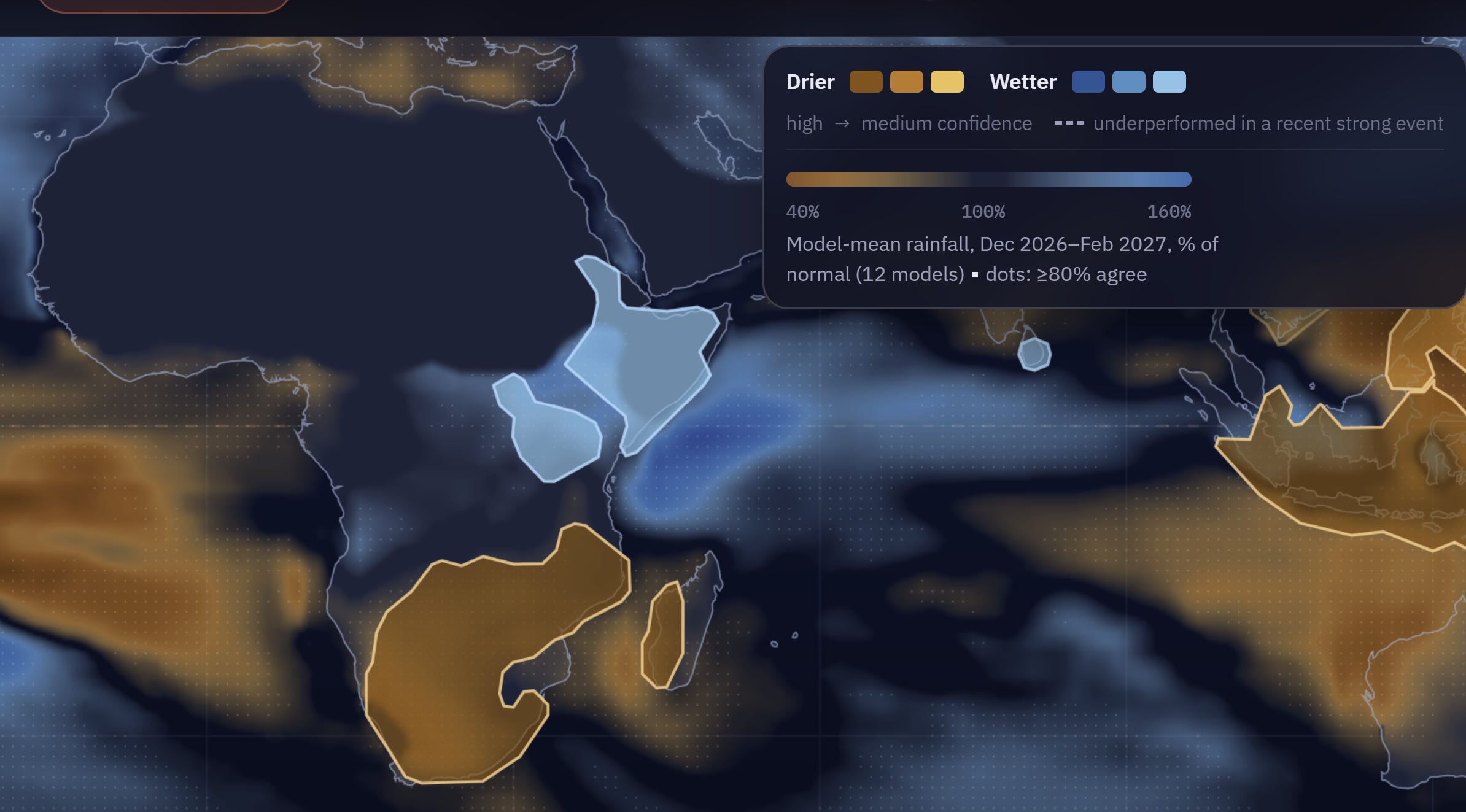
In parts of southern Africa, El Niño can substantially reduce rainfall during critical agricultural growing seasons.
When people depend on rainfall to grow the food they eat and the crops they sell, a failed rainy season is not simply an inconvenience.
It’s a humanitarian crisis.
It means families losing their incomes, children experiencing malnutrition and communities becoming dependent on emergency food assistance.
Meanwhile, in parts of eastern Africa, El Niño can contribute to exceptionally heavy rainfall, particularly during the October through December rainy season.
That means one El Niño event can contribute to drought-related humanitarian crises in one part of the continent and flood-related humanitarian crises in another.
And many of the countries experiencing these impacts are among those that have historically contributed the least to global greenhouse gas emissions.
Keep that in mind when we get into our discussion of international climate finance later this morning.
India and South Asia


El Niño can also influence the summer monsoon in India and neighboring regions.
Hundreds of millions of people depend directly or indirectly on that rainfall. It replenishes reservoirs, supports agriculture and contributes to electricity generation.
El Niño is associated with an increased likelihood of a weaker Indian summer monsoon, although the relationship isn’t consistent across every event.
Relatively small changes in the timing or distribution of monsoon rainfall can have enormous economic consequences.
And historically, as we’ll discuss in a few minutes, some of the most extreme disruptions to that rainfall have had devastating consequences for human populations.
El Niño and hurricanes
And, of course, one of the relationships between El Niño and weather that we’ve discussed extensively this year is its influence on hurricane activity.
For a hurricane to develop and intensify, it needs more than warm water.
It also needs atmospheric conditions that allow thunderstorms to organize into a relatively coherent system.
When winds near the ocean surface are moving differently from winds higher in the atmosphere, those differences can disrupt the structure of a developing hurricane.
We call that wind shear.
During El Niño, winds higher in the atmosphere tend to change in ways that increase this disruptive wind shear over parts of the tropical Atlantic.
That makes conditions less favorable for hurricanes to develop and strengthen.
Meanwhile, across parts of the eastern and central Pacific, El Niño can create conditions more favorable for tropical cyclone activity.
And we’ve seen a remarkable contrast between Atlantic and Pacific hurricane activity this year.
But I want to reiterate something that I say every hurricane season: a quiet hurricane season is not synonymous with a safe hurricane season.
Hurricane Andrew occurred during a relatively inactive Atlantic hurricane season in 1992.
It only takes one storm hitting the wrong place.
El Niño and the global economy
There’s another reason you should care about El Niño, even if the weather where you live doesn’t change very much.
The food you eat, the coffee you drink, the clothes you wear and the electricity you use all depend, to varying degrees, on environmental conditions somewhere.
A drought in a major coffee-producing region can affect the price you pay for coffee.
Declining rainfall can reduce the amount of electricity a country is capable of producing through hydroelectric dams.
Flooding can destroy roads, railways and ports, disrupting the movement of goods.
Changes in ocean temperatures can disrupt fisheries and affect the availability of seafood.
And all of these disruptions can occur simultaneously, across different parts of the world, as a result of the same climate phenomenon.
We have built a global economy that depends on relatively predictable environmental conditions.
For generations, we’ve made decisions about where to grow food, where to build infrastructure, where to establish cities and how to manage water resources based on our understanding of what those conditions are likely to be.
El Niño periodically disrupts those conditions.
Climate change is altering them over the long term.
And that combination presents a very different challenge from either phenomenon in isolation.
How scientists observe and predict El Niño
For most of human history, we had very little ability to observe what was happening across enormous portions of our planet. We had observations from ships, coastal communities and scattered scientific expeditions.
But if you wanted to know precisely what was happening in the middle of the Pacific Ocean, thousands of miles from the nearest major population center, your options were fairly limited.
Today, we have networks of instruments floating across the Pacific.
They measure ocean temperatures, atmospheric conditions, wind speeds and changes happening beneath the ocean surface.
We have satellites that allow us to observe temperature patterns across virtually the entire ocean.
We have instruments that travel beneath the surface, collecting information about how the temperature of the ocean changes with depth.
And we have computer models that use those observations to estimate how conditions may evolve over the coming months.
Scientists divide the tropical Pacific into several different monitoring regions.
The one you’ll hear referenced most frequently is called Niño 3.4.
That region covers a substantial portion of the central and eastern tropical Pacific.
And what scientists are looking at isn’t simply how warm the water is.
They’re looking at how unusually warm that water is.
That brings us to a term we’re going to use quite a bit over the remainder of today’s show: temperature anomaly.
A temperature anomaly is simply the difference between the temperature we’re observing and some established reference average.
Seventy degrees in Washington, DC, in January is a substantially different story from seventy degrees in Washington, DC, in May.
There’s nothing inherently remarkable about a temperature of seventy degrees.
It’s remarkable because of how much it differs from what we would ordinarily expect at that particular time and place.
When we discuss changes in global temperatures, we often use anomalies for the same reason.
And the reference period we use matters.
When we talk about ocean temperature anomalies in the Pacific, we’re generally comparing temperatures to a more recent historical average.
When we talk about the Paris Agreement and global warming of 1.5 degrees Celsius, we’re comparing global temperatures to estimates of temperatures before widespread industrialization.
Those numbers are measuring different things.
Scientists use sustained changes in ocean temperatures, along with observations of how the atmosphere is responding, to determine whether we’re experiencing El Niño.
An exceptionally warm week isn’t necessarily sufficient to establish that an exceptionally powerful El Niño has developed.
We need to look at how widespread that warming is, how long it persists and what’s happening in the atmosphere above it.
And predicting how those conditions are going to evolve is one of the most important things our climate scientists do.
Because a forecast issued months before the most significant impacts of El Niño occur gives governments and humanitarian organizations an opportunity to prepare.
It gives them an opportunity to save lives.
And perhaps the best illustration of why that matters comes from what happened in 1877.
The Great El Niño of 1877 and a history of extreme El Niño events
The Great El Niño of 1877–1878
Between 1876 and 1878, more than 50 million died in a series of interconnected famines across Asia, Africa and South America.
Just about three percent of the entire human population at the time.
Proportionally, that would be equivalent to losing roughly 250 million people today.
And at the center of that catastrophe was one of the most powerful El Niño events scientists have ever identified.
The 1877–1878 El Niño has long been considered a historical benchmark for extreme El Niño events, potentially exceeding many of the strongest events observed in the modern instrumental record.
Across vast portions of Asia, rains that entire civilizations had depended on for centuries failed.
And then they failed again.
Crops died. Rivers and reservoirs shrank. Livestock perished. Food prices skyrocketed.
In India, historical estimates place the death toll between approximately 12 and 29 million people.
In China, estimates range from approximately 19 to 30 million.
In Brazil, some estimates place the death toll at approximately two million.
There were additional famines across parts of Africa and elsewhere.
The precise number of people who died will probably never be known.
But when we talk about the deaths associated with the Great El Niño, we need to be very careful about how we assign responsibility.
Because tens of millions of people did not die simply because the Pacific Ocean got warmer.
They died because prolonged drought and agricultural failures intersected with poverty, disease, inequality and political systems that failed to protect them.
India, at the time, was under British colonial rule.
As crops failed and millions of people faced starvation, India continued exporting grain to Britain.
Colonial authorities resisted regulating food prices and continued demanding taxes from agricultural communities whose crops had failed.
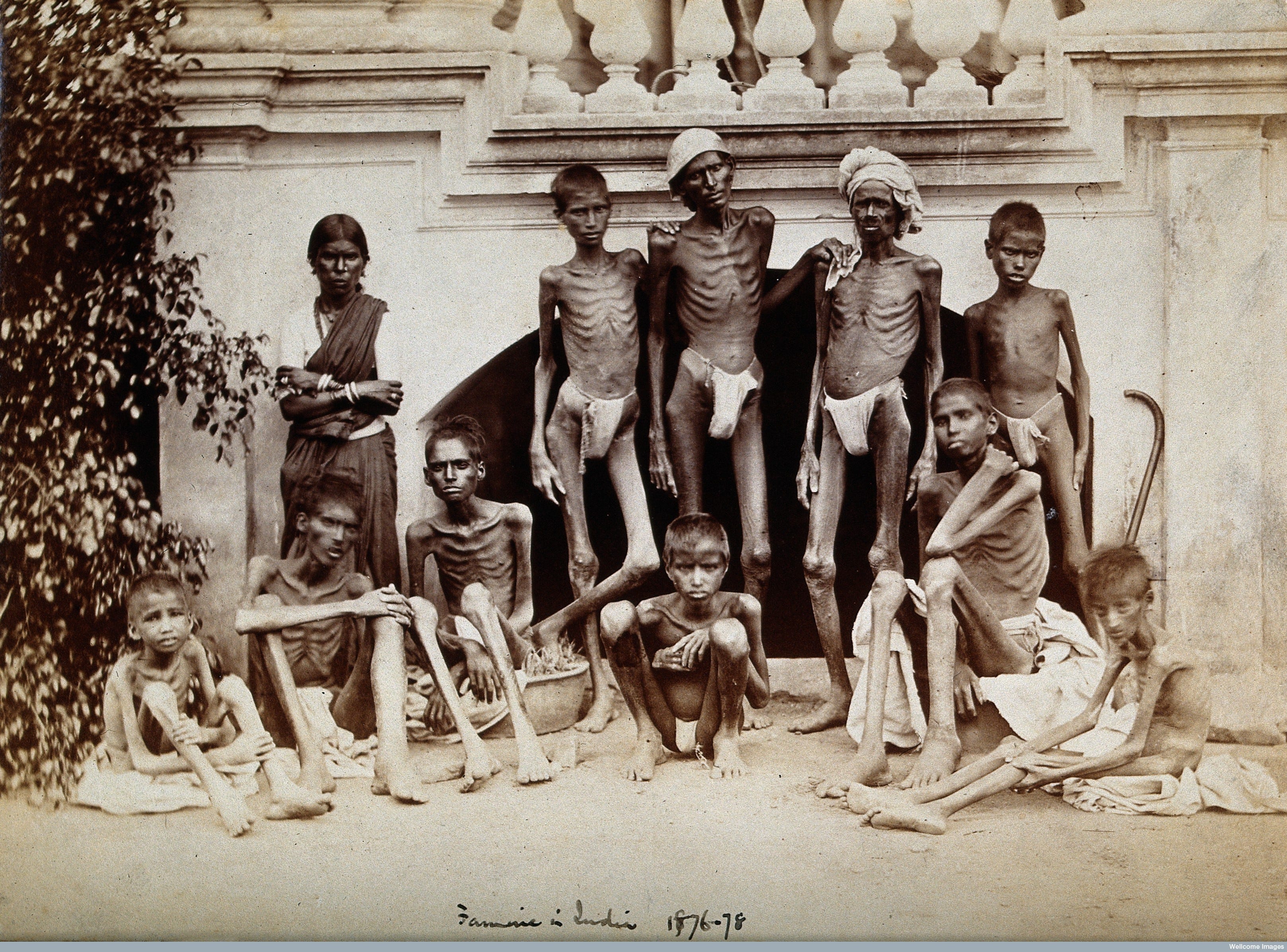
When the government did establish relief programs, starving people were often required to perform physically demanding manual labor in exchange for food.
The daily ration established under British administrator Sir Richard Temple amounted to approximately 1,627 calories.
That was supposed to sustain people who were already suffering from malnutrition while they performed hard labor.
Many died not directly from starvation, but from diseases like cholera, dysentery and malaria, which spread among populations already weakened by hunger.
The British government couldn’t control whether it rained in India.
But it could control whether food was exported while people starved.
It could control whether taxes were collected from farmers whose crops had failed.
It could control how much food was provided to starving children and their families.
Those were political decisions.
In his book Late Victorian Holocausts: El Niño Famines and the Making of the Third World, historian Mike Davis documented how imperialism and economic policies compounded these environmental disasters and helped establish inequalities that persist to this day.
In 2018, Davis and a team of climate scientists published an extensive reconstruction of the weather and ocean conditions responsible for the global famine in the Journal of Climate.
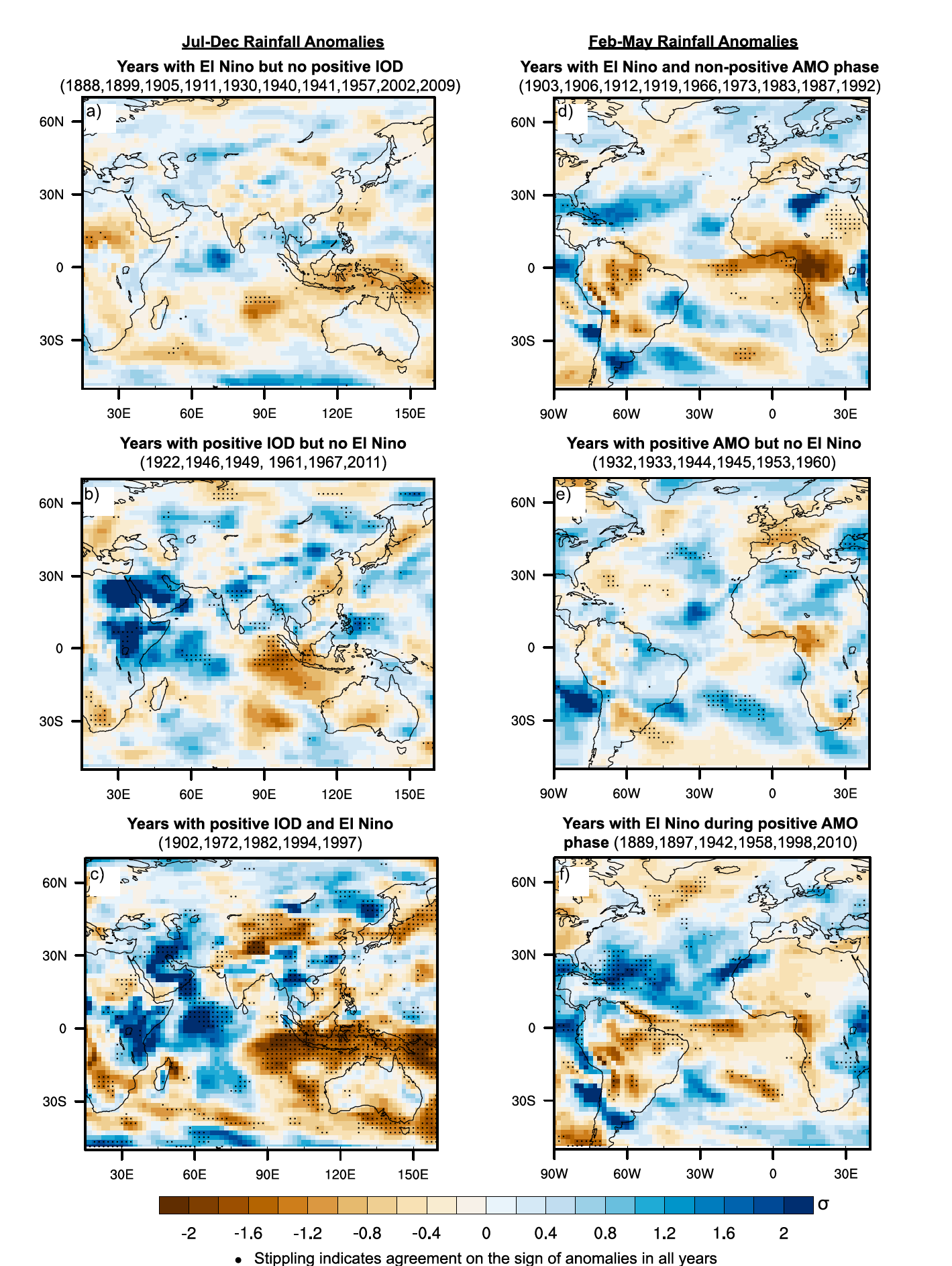
They reconstructed a remarkable sequence of events.
An extended period of cooler conditions in the tropical Pacific was followed by extraordinarily intense El Niño conditions.
Exceptional temperature differences across the Indian Ocean further disrupted rainfall patterns.
Unusually warm conditions in the North Atlantic contributed to the extraordinary geographic extent of the drought.
What made the Great Drought so devastating was not simply the intensity of one event in one ocean. It was the combination of several major disruptions to Earth’s climate system occurring in relatively rapid succession.
The researchers found that monsoon-dependent Asia experienced its most intense drought in approximately 800 years.
And they warned that the recurrence of comparable climate conditions, compounded by human-caused warming, could once again threaten global food security.
That study was published eight years ago.
And here we are, in November of 2026, watching an extraordinarily powerful El Niño develop on a substantially warmer planet.
We have scientific capabilities today that would have been unimaginable in 1877.
We have satellites. We have instruments monitoring the ocean around the clock. We have sophisticated climate models, international early warning systems and the ability to anticipate agricultural disruptions months before they occur.
We have the technological capacity to produce, preserve and transport food on a scale that didn’t exist 150 years ago.
But having the scientific knowledge to anticipate a disaster isn’t the same as having the political will to prevent one.
And as governments cut international humanitarian assistance, dismantle scientific monitoring programs and retreat from their international climate commitments, I think the history of the 1877 El Niño deserves considerably more attention than it’s getting.
More than 50 million people died during a climate catastrophe that unfolded before human-caused global warming had substantially altered our planet.
The greatest lesson of the 1877 El Niño isn’t simply that the Pacific Ocean is capable of producing extraordinary disruptions to global weather.
It’s that the severity of a natural hazard does not alone determine how many people die.
Governments make decisions that determine who is protected, who receives assistance, who has access to food and whose suffering is considered an acceptable consequence of economic policy.
That was true in 1877.
It’s true today.
The 1982–1983 El Niño
The 1982–1983 El Niño was one of the most powerful events observed during the twentieth century.
And it exposed just how limited our ability to monitor and forecast these events was at the time.
Western South America experienced devastating flooding. Marine ecosystems and fisheries were disrupted. Parts of Australia and Southeast Asia experienced severe drought.
The scale of the disaster helped motivate a transformation in the way scientists observed the tropical Pacific.
Many of the capabilities we have today to monitor what’s happening in the open ocean grew out of efforts to ensure that an event of that magnitude would not catch the world by surprise again.
That’s an important part of the history of environmental science.
Scientific advances often emerge from disasters that expose the limitations of what we know, what we’re capable of measuring and what we’re capable of predicting.
And that’s precisely why we invest in scientific institutions before disasters occur.
The 1997–1998 El Niño
For a lot of people, the 1997–1998 El Niño was when the term El Niño entered their everyday vocabulary.
It was discussed so frequently in the news that it became part of popular culture.
But for millions of people, there was nothing particularly funny about what was happening.
Indonesia experienced enormous fires and a regional air pollution crisis.
Communities along the Pacific coast of South America experienced catastrophic flooding.
Coral reefs across large portions of the world experienced widespread bleaching.
And 1998 became the hottest year in the instrumental record at the time.
For years afterward, that global temperature record became a favorite talking point among people attempting to deny the existence of climate change.
They would start their analysis in 1998, an exceptionally warm year influenced by an extraordinarily powerful El Niño, and use subsequent fluctuations in temperature to argue that global warming had stopped.
It hadn’t.
They were using a natural, temporary peak in global temperatures as the starting point for evaluating a much longer-term trend.
And if you start measuring from the top of a particularly large wave, the water immediately afterward may appear to be receding, even as the tide continues to rise.
The 2015–2016 El Niño
By the time the 2015–2016 El Niño developed, the underlying temperature of our planet had changed substantially.
We experienced successive global temperature records.
There were widespread agricultural losses, droughts and food security crises.
The Great Barrier Reef experienced devastating coral bleaching.
And the international scientific community was increasingly focused on how natural climate variability was interacting with human-caused global warming.
2015 was also the year the Paris Agreement was adopted.
World leaders were committing to limit global warming to well below two degrees Celsius and to pursue efforts to limit warming to 1.5 degrees.
Meanwhile, the physical conditions of the planet were making the urgency of those commitments increasingly apparent.
The 2023–2024 El Niño
And then came the El Niño of 2023 and 2024.
We experienced record-breaking global temperatures, extreme ocean warmth, widespread marine heat stress and devastating drought in parts of the Amazon.
According to the World Meteorological Organization, 2024 became the first calendar year in the instrumental record with an average global temperature exceeding 1.5 degrees Celsius above preindustrial levels.
That was less than a decade after the Paris Agreement was adopted.
Now, that doesn’t mean the long-term Paris Agreement threshold was officially breached in 2024.
But it should have been an extraordinary wake-up call.
One of the things I want you to take away from the history of these events is that El Niño has been occurring for thousands of years.
But the conditions under which these events are occurring are changing.
The El Niño of 1877 developed on a considerably cooler planet than the El Niño of 1982.
The El Niño of 1982 developed on a cooler planet than the El Niño of 1997.
And the El Niño we’re experiencing right now is developing on a planet that has accumulated even more heat.
The natural phenomenon isn’t new.
The environment in which it’s occurring is.
The current El Niño: What are scientists seeing?
I’ve spent much of our first hour discussing El Niño, what causes it, how it influences weather around the world and what some of the most consequential El Niño events in modern history have looked like.
Which brings us to what’s happening in the Pacific right now.
The November 12 assessment from NOAA’s Climate Prediction Center describes an exceptionally powerful El Niño that continues to strengthen.
Temperatures in the central and eastern tropical Pacific, in that primary monitoring region we discussed earlier, were approximately 2.5 degrees Celsius above normal in the reported weekly observations.
That’s approximately 4.5 degrees Fahrenheit above normal.
Farther east, temperature departures were even greater.
In the monitoring region closest to South America, NOAA reported a temperature anomaly of approximately 4.4 degrees Celsius.
That’s nearly eight degrees Fahrenheit above normal.
Now, a difference of eight degrees in the temperature of the air might not seem particularly remarkable to you.
The temperature outside your house might change by eight degrees over the course of an hour.
But we’re not talking about the temperature of the air outside your house.
We’re talking about the average temperature of the surface of an enormous region of ocean.
Water requires substantially more energy than air to change temperature.
And that’s part of the reason the ocean is such an important component of Earth’s climate system. It can absorb and store enormous quantities of heat.
So when we’re seeing temperature departures of this magnitude across large portions of the Pacific Ocean, we’re talking about a tremendous redistribution of energy within our climate system.
And what scientists are observing beneath the surface is particularly remarkable.
In parts of the eastern Pacific, temperatures below the ocean surface have exceeded normal conditions for those depths by more than ten degrees Celsius.
That’s eighteen degrees Fahrenheit.
Again, that doesn’t mean the entire Pacific Ocean is eighteen degrees warmer than normal.
But it tells us something about the extraordinary distribution of warm water beneath the surface in that part of the ocean.
Could this become the strongest El Niño ever recorded?
According to NOAA’s November assessment, there is approximately a sixty percent chance that the current event could exceed previous El Niños dating back to 1950, based on the agency’s relative ocean temperature index.
There is also a greater than 79 percent chance that strong or very strong conditions persist through January, February and March of 2027.
You’ve probably seen the term Super El Niño used in some of the reporting about this event.
Now Super El Niño isn’t a universally standardized scientific classification. Neither is monster El Nino, Godzilla El Nino, nor my personal favorite, Hell Nino.
And whether this particular event ultimately becomes the strongest on record depends, in part, on how we’re measuring and comparing these events.
We should also recognize that our detailed observational records don’t extend back indefinitely.
Comparing the current event with the Great El Niño of 1877 involves reconstructing historical ocean temperatures from considerably fewer observations than we have available today.
So while the possibility of a historically unprecedented event deserves serious attention, we shouldn’t treat that possibility as an established fact.
An El Niño that produces the greatest warming near South America isn’t necessarily the same El Niño that produces the greatest warming across the central Pacific.
And an El Niño with the strongest ocean temperature anomaly isn’t necessarily the El Niño that produces the most destructive consequences for human communities.
This distinction matters.
We have a tendency in disaster reporting to rank environmental events by a single number.
We rank hurricanes by their wind speeds, though other factors often determine the most damage done.
We rank earthquakes by their magnitude, though depth and geology matter.
We rank El Niño events by ocean temperature departures.
Those measurements are useful. But they’re not comprehensive assessments of the threat those events pose to human life.
There are relatively weak hurricanes that have killed thousands of people.
There are extraordinarily powerful hurricanes that have remained over the open ocean and harmed virtually no one.
And there are differences in how individual El Niño events distribute exceptional rainfall, drought, heat and other hazardous conditions across the planet.
So while we should be paying attention to the possibility that this becomes a record-strength event, we should also be paying attention to what this event means for people.
How long will it last?
NOAA’s November forecast gives El Niño a near-certain probability of persisting through the Northern Hemisphere winter.
For March, April and May of next year, there is an 80 percent probability of continued El Niño conditions.
By April, May and June, that probability drops to 38 percent, with neutral conditions becoming more likely.
But the consequences of El Niño don’t necessarily disappear when the event itself ends.
The climate system doesn’t respond instantaneously.
Historically, some of the warmest global temperatures associated with major El Niño events have occurred in the calendar year following their development.
That was the case in 1998.
It was the case in 2016.
And it was the case in 2024.
And that’s why the possibility of another record-breaking year in 2027 deserves serious consideration.
We’re already experiencing exceptional global temperatures.
We have an extraordinarily powerful El Niño developing.
And we continue to release greenhouse gases into the atmosphere, increasing the amount of heat retained within our climate system.
Those are three realities that we need to consider together.
El Niño and the world’s ongoing human rights crises
Earlier this morning, we talked about the Great El Niño of 1877 and the tens of millions of people who died in the famines associated with it.
We talked about how those deaths were not simply the product of exceptional weather, but of political decisions, restrictions on access to food, economic exploitation and the failure of governments to protect vulnerable people.
I want to return to that discussion now because there are some extraordinarily disturbing parallels between the conditions that existed then and some of the conditions that exist today.
Last Friday, the World Food Programme released its global outlook for 2027.
According to that report, 266 million people around the world are already experiencing acute hunger.
The World Food Programme needs $12.1 billion to provide assistance to 91 million people next year.
And humanitarian assessments suggest that tens of millions of additional people could experience increased hunger as a consequence of this El Niño.
These are people who, in many cases, have already exhausted the resources they had available to survive another crisis.
They’ve been displaced by war. They’ve lost their homes. They’ve lost access to agricultural land. They’ve lost access to healthcare, clean water and the infrastructure that once sustained their communities.
And now we’re looking at the possibility of an exceptionally powerful El Niño further compromising their ability to survive.
Somalia and the Horn of Africa
One of the regions I’m most concerned about over the coming months is the Horn of Africa.
Across large portions of central and southern Somalia, regional climate assessments have indicated as much as a 90 percent probability of above-normal rainfall during the October through December rainy season.
For some communities, that rain could provide much-needed relief from drought.
But for others, particularly those living in displacement camps or communities along river systems, it could be catastrophic.
The September food security assessment for Somalia projected that 5.4 million people would experience crisis levels of hunger or worse during the final three months of this year.
Nearly two million children under the age of five are expected to suffer acute malnutrition between July of this year and June of next year.
More than 433,000 of those children are projected to suffer from severe acute malnutrition.
Somalia’s disaster management agency estimates that between 2.5 and 3.5 million people could be exposed to flooding.
And humanitarian organizations have warned that extensive, severe flooding could increase the risk of famine in parts of southern Somalia.
Consider what happens when a road leading to a treatment center becomes impassable.
A child doesn’t have to drown in a flood to become one of its casualties.
That child can die because the food and medical supplies that would have kept them alive cannot reach them.
Floodwaters can contaminate drinking water, facilitate the spread of cholera and destroy the sanitation facilities that displaced communities depend on.
And humanitarian organizations are already struggling to reach some communities because of armed conflict and insecurity.
The rain isn’t creating those barriers.
It’s adding another one.
Sudan and South Sudan
In Sudan, we’re dealing with a humanitarian catastrophe created by war, mass displacement, atrocities against civilians and the destruction of the infrastructure necessary to sustain human life.
And the environmental conditions developing across this region are particularly concerning.
Parts of the region are experiencing severe rainfall deficits, while communities in Sudan, particularly in Darfur and Kordofan, face the risk of famine.
Humanitarian organizations have developed a dedicated six-month El Niño response plan for approximately 3.86 million people in Darfur and Kordofan, requiring nearly $360 million through March of next year.
For people who have been forcibly displaced from agricultural communities, another failed harvest is an economic catastrophe.
For people living in areas where armed groups restrict access to humanitarian assistance, declining local food production can make them even more dependent on aid that may never reach them.
And for survivors of violence who have already walked extraordinary distances to find safety, further shortages of food and water can compel them to move again.
We need to understand that environmental disasters can exacerbate human rights violations without being their original cause.
El Niño did not start the war in Sudan.
It did not destroy Sudan’s hospitals, forcibly displace its civilian population or obstruct the delivery of humanitarian assistance.
But it can make the consequences of those actions considerably more deadly.
Ethiopia
There are similar concerns in Ethiopia, where drought and renewed fighting have intersected in agricultural communities across parts of the country.
An analysis published earlier this month by the International Food Policy Research Institute found that rainfall between June and September was among the three lowest recorded since 1991 across much of the region normally dependent on those rains.
The country’s main harvest could be as much as 30 percent below average.
Meanwhile, millions of people in Tigray require emergency food assistance, and renewed fighting threatens agricultural production and access to food.
Farther south, parts of Ethiopia face the opposite problem: exceptionally heavy rainfall and flooding associated with the current El Niño.
So within one country, we’re looking at communities dealing with drought, communities facing flooding and communities attempting to survive armed conflict.
And the humanitarian organizations tasked with responding to these overlapping crises are operating under enormous financial constraints.
Palestine
And then there’s Gaza, where we’re already seeing what happens when extreme weather intersects with the systematic destruction of the infrastructure necessary to sustain human life.
Gaza is entering its fourth winter since October of 2023.
According to preliminary assessments published by the United Nations, heavy rainfall earlier this month affected approximately 226,000 people.
More than 40,000 shelters were reportedly damaged, including more than 9,000 that were damaged beyond repair.
More than 5,000 families were reportedly left without shelter.
Nearly a thousand latrines were damaged.
Floodwaters contaminated with sewage inundated displacement sites.
Healthcare facilities were damaged, and thousands of children lost access to what little educational infrastructure remains available to them.
On November 13, a nine-month-old Palestinian infant reportedly died from hypothermia.
And according to the United Nations, more than 150,000 tents procured by humanitarian organizations and governments were still outside Gaza awaiting entry.
The tents exist.
The people who need them exist.
The ability to transport those tents into Gaza exists.
What’s preventing those families from having adequate shelter is not a limitation of our technological capabilities.
And as we move further into winter, we’re talking about a population that is exceptionally vulnerable to flooding, exposure, respiratory infections, waterborne diseases and malnutrition.
People with amputations, people recovering from traumatic injuries, pregnant women, newborns, children whose immune systems have been compromised by prolonged malnutrition.
These are the people who will be exposed to whatever weather develops across the eastern Mediterranean this winter.
Now, I want to be scientifically precise here.
The relationship between El Niño and winter rainfall in the eastern Mediterranean is considerably less consistent than the relationship we see in places like Somalia.
We cannot simply attribute every storm affecting Gaza to El Niño, nor can we confidently predict an exceptionally wet winter in Gaza based on El Niño alone.
But we can say, with considerable confidence, that even relatively ordinary winter weather poses an extraordinary threat to the Palestinian population under these conditions.
And any additional extreme weather would compound that threat.
The United Nations has already identified much of the suffering associated with these recent storms as preventable.
You cannot destroy people’s homes, restrict their access to shelter, compromise their water and sanitation infrastructure, and then attribute their deaths to the weather.
Afghanistan
Another country we should be watching particularly closely this winter is Afghanistan.
According to the International Organization for Migration, a strong El Niño could increase the likelihood of above-average precipitation across Afghanistan between October of this year and April of next year.
That includes both rainfall and snowfall.
Under ordinary circumstances, additional snowfall in Afghanistan’s mountains can be beneficial. Mountain snow provides water for agriculture and communities as it melts throughout the spring and summer.
But the conditions in Afghanistan right now are anything but ordinary.
Millions of Afghans have returned from Iran and Pakistan in recent years, many as a consequence of deportations and forced returns.
They’re returning to a country experiencing widespread poverty, severe restrictions on the rights of women and girls, inadequate housing, food insecurity and significant reductions in humanitarian assistance.
The latest food security assessment projects that approximately 19.2 million people could experience crisis or emergency levels of hunger between November and April.
And the International Organization for Migration has warned that more than 140,000 vulnerable people could be left without critical winter assistance because of inadequate funding.
Nearly three-quarters of Afghan communities surveyed by IOM rely on unpaved roads, many of which become inaccessible during winter.
Heavy snowfall can effectively isolate entire communities from humanitarian assistance.
And we have to consider what that means specifically for Afghan women.
Restrictions on women’s employment, education and movement already compromise their ability to access resources, earn an income and receive healthcare.
Those restrictions can become even more consequential during an environmental emergency.
The freedom to evacuate, seek medical treatment, earn money or independently access humanitarian assistance can determine whether someone survives a disaster.
Human rights are a component of disaster resilience.
Myanmar and the Rohingya
Across Southeast Asia, the World Meteorological Organization has warned of increased heat, reduced rainfall, water shortages and elevated risks of wildfires and smoke pollution associated with El Niño.
Among the populations I’m particularly concerned about are those displaced by the ongoing violence in Myanmar.
By the end of August, approximately four million people were estimated to be internally displaced within Myanmar.
Another 1.2 million people displaced from Myanmar are living in Bangladesh, predominantly Rohingya refugees.
Many have spent years living in densely populated refugee settlements with limited resources, limited economic opportunities and inadequate infrastructure.
When temperatures rise, people living in makeshift shelters cannot necessarily escape the heat.
When rainfall declines, communities already dependent on humanitarian organizations for drinking water become increasingly vulnerable to water shortages.
When food production declines and prices increase, people who are prohibited from working or who have limited access to employment have considerably fewer options available to them.
And when wildfires produce hazardous smoke, people with limited access to healthcare and adequate shelter are particularly vulnerable.
The exact distribution of El Niño-related rainfall and heat across Myanmar and Bangladesh will depend on regional conditions and the season.
But the broader risks to food production, water availability and public health are particularly concerning for communities already experiencing persecution and displacement.
Yemen
In Yemen, years of war, economic deterioration and displacement have created another extraordinarily vulnerable population.
The latest food security assessments project that approximately 5.4 million people in government-controlled areas alone will experience crisis levels of hunger or worse during the final three months of this year.
Approximately 1.8 million of those people are projected to experience emergency levels of hunger.
Yemen is particularly vulnerable to changes in global food production because of its dependence on imported food.
So even if the most severe weather associated with this El Niño occurs thousands of miles away, Yemen could still experience some of its economic consequences.
Agricultural losses elsewhere can drive up food prices.
Disruptions to transportation networks can increase the cost of imports.
And competition for international humanitarian resources can leave existing emergency response programs inadequately funded.
We shouldn’t evaluate the humanitarian impacts of El Niño solely by looking at a map of where temperatures and rainfall are expected to change.
We also need to look at where the food is produced, where it is consumed, how it gets there and who can afford it.
Haiti and Central America
Closer to home, across parts of Central America and the Caribbean, irregular rainfall, elevated temperatures and agricultural stress threaten communities already experiencing food insecurity.
The Famine Early Warning Systems Network has documented substantial rainfall deficits across the Central American Dry Corridor, with localized crop losses and deteriorating livestock conditions.
In Haiti, rainfall has been uneven, both geographically and throughout the rainy season.
These conditions are developing amid political instability, armed violence, displacement and widespread food insecurity.
In Haiti, armed groups have disrupted transportation networks, restricted access to agricultural areas and complicated the delivery of humanitarian assistance.
When agricultural production declines under those circumstances, people become increasingly dependent on markets that may be inaccessible, unsafe or unaffordable.
Across Central America, another failed harvest can mean the exhaustion of whatever resources a family had left to remain in their community.
And then, when those families are forced to leave, they’re often confronted by increasingly hostile immigration policies.
We talk about climate migration as though it’s some distant, hypothetical consequence of climate change.
People are already moving because the environmental, economic and political conditions necessary to sustain their lives no longer exist where they live.
And we’re entering a period in which those conditions could deteriorate further.
The global humanitarian funding crisis
What makes all of this particularly concerning is that we’re experiencing this El Niño during a period of extraordinary financial strain on the international humanitarian system.
As of October 22, according to the International Food Policy Research Institute, humanitarian response plans for Somalia, South Sudan and Sudan had received approximately 34 percent, 40 percent and 46 percent of their required funding, respectively.
That was before many of the most consequential impacts of this El Niño were expected to materialize.
The United Nations, the World Meteorological Organization and humanitarian organizations have been calling for what is known as anticipatory action.
And the concept is remarkably simple.
When you know a flood is likely to occur, you move food, medicine and emergency supplies into the communities that will need them before the roads become impassable.
When you know a drought is likely to occur, you provide farmers with seeds that are more resistant to drought, improve access to water and help families protect their livestock before they lose them.
When you know displaced populations will be exposed to dangerous winter conditions, you provide them with adequate shelter before children begin dying of hypothermia.
You don’t wait for people to die before allocating the resources that could have kept them alive.
One of the most extraordinary scientific advantages we have with El Niño is that, unlike earthquakes or many other environmental hazards, we can anticipate many of its consequences months in advance.
That gives us something that is enormously valuable in disaster management.
Time.
And what governments choose to do with that time will determine how many people survive this event.
I want you to remember those tens of millions of people who died during the Great El Niño of 1877.
The governments of the nineteenth century did not have satellites monitoring the Pacific Ocean. They didn’t have sophisticated climate models. They didn’t have a World Meteorological Organization or a United Nations capable of coordinating an international response.
We have all of those things.
We have the scientific knowledge to anticipate many of these crises.
We have the technological capabilities to respond to them.
We have the resources, collectively, to prevent an enormous amount of the suffering we’re discussing this morning.
What we lack, increasingly, is the political commitment to do so.
And that brings us to the other major difference between the El Niño of 1877 and the El Niño of 2026.
This time, we’ve substantially warmed the planet.
Climate change and El Niño
Whenever we experience a powerful El Niño, there tends to be a renewed effort among people who deny or downplay climate change to attribute all of the warming we’re experiencing to El Niño.
And there is also a tendency, sometimes among people who are deeply concerned about climate change, to attribute the development of El Niño itself entirely to human-caused warming.
Neither of those explanations accurately represents our understanding of the science.
So there are a few different questions I want to address here.
Does climate change cause El Niño?
No.
We have evidence of El Niño events occurring thousands of years before humans began burning fossil fuels on any meaningful scale.
Scientists have reconstructed historical El Niño activity using old corals, sediments and other natural records.
El Niño is part of the natural variability of Earth’s climate system.
But I don’t want anyone to confuse that statement with a finding that human-caused climate change cannot influence El Niño.
Hurricanes are naturally occurring.
Wildfires are naturally occurring.
Floods are naturally occurring.
Heatwaves are naturally occurring.
The existence of these phenomena before industrialization does not preclude the possibility that humans have changed their behavior, their frequency, their intensity or their consequences.
We’ve changed the environment in which these things occur.
Does El Niño cause global warming?
El Niño can temporarily raise global average atmospheric temperatures.
It changes the way heat is distributed across the Pacific Ocean and exchanged between the ocean and atmosphere.
That warming can affect the average temperature of the entire planet.
But El Niño does not explain the long-term warming trend we’ve observed since industrialization.
Think of global temperatures like the surface of the ocean.
On the surface, we have waves.
Some are bigger than others. Some push the water higher. Some create temporary depressions in the water.
Those waves represent natural fluctuations in Earth’s climate, including El Niño and La Niña.
But beneath those waves, the tide is rising.
That rising tide represents human-caused climate change.
When a particularly large wave comes along during a higher tide, the water reaches farther inland than it would have during a lower tide.
And when that wave passes, the tide doesn’t suddenly return to its previous level.
That’s the relationship we’re talking about.
We can observe a temporary decline in global temperatures following a major El Niño without seeing a reversal of human-caused global warming.
We can experience a cooler year during La Niña without seeing a reversal of human-caused global warming.
And this is why cherry-picking individual years to make arguments about long-term climate trends is scientifically indefensible.
You cannot establish whether the tide is rising or falling by measuring the height of a single wave.
Is climate change making El Niño stronger?
This is one of the more complicated questions in contemporary climate science.
There is research suggesting that extreme El Niño events could become more frequent in a warmer world.
There is research suggesting that climate change could alter where warming occurs across the Pacific and how that warming influences the atmosphere.
And there is research examining whether recent decades of El Niño and La Niña activity differ substantially from what occurred before industrialization.
But there is still considerable uncertainty about precisely how the strength and frequency of El Niño events will change in response to continued greenhouse gas emissions.
Part of the challenge is that we’re studying a naturally variable phenomenon.
Individual El Niño events differ from one another substantially.
And while we have methods for reconstructing El Niño activity going back thousands of years, our detailed, direct observations of ocean and atmospheric conditions extend back a comparatively short period of time.
We’re also trying to understand how changes in the average temperature of the Pacific, differences in warming between one part of the ocean and another, and changes in atmospheric circulation will interact.
Those are complicated questions.
And I think it’s important that we acknowledge the limitations of our scientific understanding where those limitations exist.
But uncertainty about whether El Niño itself will become stronger is not equivalent to uncertainty about whether its impacts will become more severe.
There are aspects of this relationship that we understand quite well.
Heavier rainfall
One of the fundamental principles of atmospheric science is that warmer air can hold more water vapor.
For every additional degree Celsius of warming, the amount of water vapor the air can hold increases by approximately seven percent, under comparable conditions.
That does not mean every storm will produce seven percent more rainfall.
Rainfall depends on a number of other factors, including how much moisture is available, how air moves through the atmosphere and how storms develop.
But when a weather system develops under conditions favorable for heavy rainfall, a warmer atmosphere can provide more moisture.
So when El Niño creates conditions favorable for exceptional rainfall in parts of South America or the southern United States, those conditions are developing within an atmosphere that is capable of holding more moisture than it could a century ago.
The Intergovernmental Panel on Climate Change has assessed that rainfall fluctuations associated with El Niño and La Niña are very likely to become more pronounced under continued warming in intermediate and higher emissions scenarios during the latter half of this century.
More severe drought
On the other side of that equation, when El Niño suppresses rainfall in a particular region, those communities are dealing with the effects of reduced rainfall in a warmer environment.
Higher temperatures can increase the rate at which moisture is lost from soils, reservoirs and vegetation.
Crops become stressed more quickly.
Water supplies can be depleted more rapidly.
Forests become more susceptible to fire.
The same reduction in rainfall that occurred several decades ago may have substantially different consequences today because of the temperature at which that drought occurs.
We don’t necessarily need less rainfall than we experienced during a previous El Niño to experience a more severe drought.
Coral reefs
Perhaps nowhere is this interaction between El Niño and long-term warming more visible than in our coral reefs.
Corals have a remarkable relationship with microscopic algae that live within their tissues.
Those algae help provide the energy the corals need to survive and grow.
When corals experience prolonged periods of excessive heat, that relationship can break down.
The corals lose those algae, along with much of their color.
That’s what we refer to as coral bleaching.
Bleaching doesn’t necessarily mean a coral is dead.
If conditions improve quickly enough, corals can recover.
But when marine heatwaves persist for extended periods of time, or when corals experience repeated episodes of bleaching without sufficient time to recover, mortality can be extensive.
As the underlying temperature of our oceans increases, it takes less additional warming to push these ecosystems beyond what they can tolerate.
And those ecosystems aren’t simply beautiful places for people to visit on vacation.
They provide habitat for marine life.
They support fisheries.
They help protect shorelines from waves and coastal erosion.
They sustain communities and economies.
When we lose coral reefs, we lose the ecological services they provide.
And some of those losses cannot be reversed on any timescale relevant to the people who depend on them.
Sea level rise
We should also consider the interactions between El Niño and rising sea levels.
One of the things that happens as the ocean warms is that it expands.
Water occupies more space as it warms through the temperature ranges typical of most of the ocean.
We are also adding water to the ocean through the melting of glaciers and ice sheets.
So the ocean is expanding, and we’re adding more water to it.
During El Niño, changes in winds and ocean circulation can also temporarily raise sea levels in some regions, particularly along the eastern Pacific.
Those temporary increases are occurring on top of an underlying rise in sea level.
And that can increase coastal flooding and erosion.
A storm that would have produced relatively minor coastal flooding several decades ago can produce more consequential flooding today, even if the storm itself is no stronger.
Because the water starts from a higher level.
Compounding disasters
And then there’s the human component.
Communities across the world are still dealing with the consequences of previous environmental disasters.
Families have been displaced by flooding.
Farmers have lost successive harvests.
Governments have accumulated debt rebuilding infrastructure.
Communities have exhausted the resources they once had available to recover.
When another disaster occurs before those people have recovered from the last one, the impacts compound.
That’s something I learned very early in my life growing up in south Mississippi, particularly in the aftermath of Hurricane Katrina.
The disaster doesn’t end when the storm passes.
For some families, the disaster continues for years.
For some communities, it never really ends.
And when another hurricane arrives, or another flood, or another economic crisis, those things happen to people who are still living with the consequences of the previous one.
That is the reality of climate change for much of the world.
It’s not simply that individual disasters become more severe.
It’s that the environmental conditions under which people are attempting to recover from those disasters are themselves deteriorating.
We are reducing the time between crises while increasing the resources required to recover from them.
And that’s one of the consequences of climate change that I think doesn’t receive nearly enough attention.
We don’t need to establish that every individual El Niño is becoming stronger to understand why powerful El Niño events are potentially more dangerous today than they were generations ago.
We have already changed the conditions under which those events occur.
And the measurements coming in from our scientists over the last several weeks illustrate just how substantially we’ve changed them.
Temperature Check: Earth’s record-breaking heat
October 2026
On November 12, NOAA released its monthly assessment of global climate conditions for October.
The average global surface temperature for October was 1.43 degrees Celsius above the twentieth-century average.
That represents the largest monthly temperature departure NOAA has recorded for any month of the year in a record extending back to 1850.
It was the fiftieth consecutive October in which global temperatures exceeded the twentieth-century average.
All ten of the warmest Octobers in NOAA’s record have occurred since 2015.
But what I find particularly remarkable in this report is what’s happening in our oceans.
For the fifth consecutive month, global ocean surface temperatures established a new record departure for that calendar month.
October’s global ocean surface temperature was 1.14 degrees Celsius above average, the largest ocean temperature departure NOAA has recorded for any month.
Global land temperatures were 2.08 degrees Celsius above average, making this the third-warmest October for land temperatures in NOAA’s record.
There was no region of land or ocean anywhere on Earth that NOAA identified as experiencing record-cold October temperatures.
And the Pacific wasn’t the only ocean experiencing extraordinary warmth.
Record temperature departures were also observed across parts of the Atlantic, Indian and Southern oceans.
El Niño is a significant contributor to the warmth we’re experiencing right now.
But the warmth we’re experiencing extends well beyond the region directly affected by El Niño.
An extraordinary October for tropical cyclones
NOAA also documented something extraordinary in global tropical cyclone activity.
Fifteen tropical storms developed around the world during October.
Twelve reached hurricane-equivalent strength, and eleven reached major hurricane-equivalent strength.
Both of those totals established new global records for October.
Ten of those eleven major storms developed across the eastern and western North Pacific.
Meanwhile, the Atlantic remained relatively quiet.
Hurricane Isaias became the latest first Atlantic hurricane of a season in the satellite record.
We’ve spent much of this morning discussing the mechanisms through which El Niño alters tropical cyclone activity.
And we’re seeing some of those patterns play out in the observational data right now.
November 20: Earth’s most anomalously hot day
And then came last Friday.
Preliminary data from Europe’s Copernicus Climate Change Service indicate that the global average temperature on November 20 was approximately 2.12 degrees Celsius above estimated preindustrial conditions.
That’s approximately 3.82 degrees Fahrenheit above preindustrial conditions.
It surpassed the previous daily anomaly record established on November 17, 2023, during the last major El Niño.
Now, I want to make an important distinction here.
When we refer to November 20 as the most anomalously hot day on record, we’re not necessarily saying it was the day with the highest absolute global average temperature.
The average temperature of Earth changes throughout the year.
Because so much of Earth’s land surface is concentrated in the Northern Hemisphere, the planet as a whole tends to reach its highest absolute temperatures during the Northern Hemisphere summer.
What makes November 20 extraordinary is how much warmer it was than we estimate the planet would ordinarily have been at this time of year before industrialization.
And that’s a particularly concerning measurement when we consider the international commitments governments have made to limit global warming.
Does experiencing a day that’s more than two degrees Celsius above preindustrial temperatures mean we’ve officially exceeded the two-degree threshold established in the Paris Agreement?
No.
But does it mean we should be extraordinarily concerned about where we’re headed?
Absolutely.
And the timing of this record is particularly remarkable.
The most anomalously hot day in the Copernicus record occurred while world leaders were attempting to negotiate an international climate agreement at COP31.
Two days later, those negotiations ended without an overarching political agreement.
The Paris Agreement: What have we accomplished?
In December of 2015, almost eleven years ago, representatives from nearly every country on Earth gathered in Paris and adopted what became the most consequential international agreement on climate change in modern history.
The central temperature objective of that agreement was to limit global warming to well below two degrees Celsius above preindustrial levels while pursuing efforts to limit warming to 1.5 degrees.
Those thresholds refer to long-term global warming.
They are not limits on how warm an individual day, month or year can become.
And that’s an important distinction.
During particularly strong El Niño events, global temperatures can temporarily exceed the underlying level of human-caused warming.
During La Niña events, global temperatures can temporarily fall below it.
But increasingly, we’re experiencing temperatures above those thresholds for longer periods of time.
In 2024, according to the World Meteorological Organization, Earth’s average annual temperature exceeded 1.5 degrees Celsius above preindustrial levels for the first time in the instrumental record.
And we’re now looking at the possibility of another extraordinary period of global warmth extending into 2027.
The frequency with which we’re experiencing temperatures above 1.5 degrees should be an indication of how close we’re getting to establishing those conditions as our long-term climate.
Has the Paris Agreement made a difference?
Yes.
And I think it’s important that we acknowledge the progress that has occurred over the last decade, particularly when we’re discussing the failures of international climate policy.
The development and deployment of renewable energy have accelerated considerably.
The cost of solar power has declined dramatically.
Battery technologies have advanced.
Electric vehicles have become increasingly accessible.
More countries have established national climate targets, incorporated climate considerations into domestic policy and developed plans to transition portions of their economies away from fossil fuels.
International climate action has improved the trajectory of projected global warming relative to some of the projections that existed before the Paris Agreement.
But improving the trajectory is not the same as getting where we need to go.
And that’s where we continue to fall short.
Global greenhouse gas emissions remain extraordinarily high.
The United Nations’ 2026 assessment of national climate commitments found meaningful progress in incorporating climate action into national policies, but concluded that the collective emissions reductions promised by governments remain substantially insufficient to limit warming to 1.5 degrees.
We’ve demonstrated that we have the technological capacity to transition away from fossil fuels.
We’ve demonstrated that renewable energy can be economically competitive.
We’ve demonstrated that we can generate electricity, transport people and manufacture goods with substantially fewer emissions.
What we haven’t demonstrated is the political capacity to implement those changes at the scale and speed necessary.
Why every fraction of a degree matters
One of the more dangerous narratives emerging in climate discussions is the idea that exceeding 1.5 degrees makes further climate action somehow pointless.
That is not how the climate system works.
A world that warms by 1.6 degrees is not the same as a world that warms by two degrees.
A world that warms by two degrees is not the same as a world that warms by three degrees.
Every additional increment of warming increases the likelihood or severity of a range of environmental hazards.
Every fraction of a degree we prevent matters.
It matters to the survival of coral reefs.
It matters to agricultural productivity.
It matters to the availability of fresh water.
It matters to coastal communities.
And it matters to the millions of people we discussed earlier this morning who are already experiencing extraordinarily precarious conditions.
There isn’t a point at which preventing additional warming becomes meaningless.
The more we’ve failed to accomplish in the past, the more consequential our decisions become today.
Which brings us to COP31.
What happened at COP31?
On Sunday, after more than two days of extended negotiations, the United Nations’ thirty-first annual climate change conference concluded in Antalya, Turkey.
And for the first time since the Copenhagen climate conference in 2009, governments failed to agree on an overarching political decision.
Now, for those unfamiliar with the United Nations climate conferences, the acronym COP stands for Conference of the Parties.
These are meetings of the countries participating in the United Nations Framework Convention on Climate Change.
The Paris Agreement emerged from that process.
International negotiations concerning emissions reductions, climate finance, adaptation, technology transfers and other aspects of climate policy occur through that process.
And one of the challenges inherent in these negotiations is that major decisions generally require consensus.
Which means that countries with fundamentally different economic interests and political priorities must agree on language establishing how the world intends to respond to climate change.
And at COP31, they couldn’t even agree on whether the overarching decision should explicitly acknowledge fossil fuels.
The fossil fuel fight
The combustion of coal, oil and natural gas is the primary driver of contemporary global warming.
This is not an unresolved question in climate science.
We’ve established where the additional carbon dioxide in the atmosphere is coming from.
We’ve established how greenhouse gases influence the Earth’s energy balance.
We’ve established that the warming we’ve observed cannot be explained by natural changes in solar activity or other natural processes alone.
The scientific evidence is overwhelming.
And yet, nearly eleven years after the Paris Agreement was adopted, international climate negotiations collapsed over whether a climate agreement should explicitly reference the primary cause of climate change.
According to reporting from Reuters and the Associated Press, Saudi Arabia was among the principal countries resisting language concerning a transition away from fossil fuels.
Russia also opposed including fossil fuel references in the overarching agreement.
Saudi Arabia and other fossil fuel-producing countries have argued that oil and natural gas will continue to be necessary components of the global energy system and that technologies designed to capture carbon emissions should receive greater emphasis.
Approximately 130 countries supported a proposal that included language on transitioning away from fossil fuels and opposed stronger language promoting carbon capture.
But when the revised draft was circulated, the explicit references to fossil fuels had been removed.
Provisions supporting carbon capture remained.
The European Union, the United Kingdom, Panama, the Marshall Islands and other countries ultimately rejected the proposed overarching agreement.
Their argument was that adopting an agreement that effectively weakened existing commitments and failed to address the principal cause of global warming would represent a step backward.
There were vulnerable countries that would have accepted the imperfect agreement because of provisions concerning electrification, oceans and financial support.
Palau was among them.
And I think it’s important to recognize the extraordinarily difficult position some of those countries were placed in.
For a small island nation confronting sea level rise, access to financial assistance can determine whether communities can remain habitable.
Those governments were forced to weigh the potential benefits of securing immediate assistance against the long-term consequences of an inadequate agreement on reducing emissions.
Carbon capture versus reducing fossil fuel consumption
One of the other major points of contention during these negotiations was the role of carbon capture.
Carbon capture refers to a collection of technologies designed to capture carbon dioxide before it’s released into the atmosphere, or in some cases to remove it from the atmosphere after it’s been emitted.
There are industrial processes where these technologies may have important applications.
There are also sectors where eliminating emissions entirely will be particularly challenging, and carbon removal may ultimately play a role in addressing those residual emissions.
But there is a substantial difference between using carbon capture to address emissions that are particularly difficult to eliminate and using the promise of carbon capture to justify continued expansion of fossil fuel production.
The scale matters.
If we’re continuing to release tens of billions of metric tons of carbon dioxide into the atmosphere every year, the existence of technologies capable of capturing a comparatively small fraction of those emissions does not resolve the underlying problem.
And the risk is that governments and fossil fuel companies use the promise of future technologies to delay emissions reductions that are technologically possible right now.
The atmosphere responds to the amount of greenhouse gases we release.
It does not respond to the number of press releases we issue about technologies we intend to develop.
The absence of the United States
Another consequential aspect of this year’s conference was the absence of direct participation by the United States government.
The United States has contributed more carbon dioxide through historical fossil fuel emissions than any other individual country.
It remains one of the world’s largest contemporary greenhouse gas emitters.
It possesses enormous scientific, technological and financial resources.
And historically, cooperation between the United States and China has played an important role in facilitating international climate agreements.
The absence of that diplomatic engagement matters.
It matters to the ability of countries to reach consensus.
It matters to international climate finance.
It matters to the willingness of other major emitters to make commitments.
And it matters to the countries that have contributed comparatively little to climate change but are experiencing some of its greatest consequences.
Climate finance and the human consequences of delay
One of the other major points of contention at COP31 involved financial assistance to developing countries.
Wealthier countries have historically contributed disproportionately to the greenhouse gas emissions responsible for contemporary global warming.
Poorer countries often have fewer resources available to adapt to the resulting environmental changes.
We are asking some of the world’s poorest governments to build infrastructure capable of withstanding increasingly severe floods, to develop agricultural systems capable of surviving increasingly severe droughts, and to provide assistance to communities displaced by rising seas.
And we’re often asking them to do those things using financial resources they simply do not possess.
Last month, during my time in Geneva participating in the United Nations climate change study programme, we spent considerable time discussing the relationship between climate finance, adaptation and development.
One of the things that becomes apparent when you examine these issues is just how expensive inaction is.
We talk about the cost of investing in infrastructure capable of withstanding floods.
But we rarely put that cost alongside the repeated expense of rebuilding the same infrastructure every time it floods.
We talk about the cost of providing farmers with resources to adapt to changing environmental conditions.
But we rarely compare that with the cost of responding to a famine after multiple harvests have failed.
We talk about the cost of developing early warning systems.
But we don’t always account for the lives those systems can save, the property they can protect and the economic disruptions they can prevent.
And in humanitarian crises, there comes a point at which no amount of money can undo the consequences of our failure to act.
You cannot bring a child who died of malnutrition back to life.
You cannot restore a species after it has gone extinct.
You cannot necessarily rebuild a community in a place that has become permanently uninhabitable.
The question is not simply whether we can afford to invest in addressing climate change.
It’s whether we can afford not to.
Did anything meaningful come out of COP31?
The failure to adopt an overarching political agreement does not mean that absolutely nothing was accomplished at COP31.
There was progress on separate negotiations concerning adaptation and a just transition.
Countries continued work on initiatives to increase electrification and accelerate the development of cleaner energy systems.
Nearly 100 countries backed a separate initiative aiming to increase electricity’s share of final energy consumption to 35 percent by 2035.
And the failure to adopt the proposed Antalya Pact does not invalidate the Paris Agreement or overturn previous international commitments.
Those commitments remain.
But the most contentious questions concerning fossil fuels and financial assistance remain unresolved.
And many of those questions will now carry over into COP32, which is scheduled to take place in Ethiopia next year.
Another year of negotiations.
Another year of greenhouse gas emissions.
Another year of rising sea levels.
Another year in which communities across the world will experience environmental disasters that governments have had decades to prepare for.
And if the current El Niño unfolds as scientists anticipate, the delegates arriving in Ethiopia next year may be doing so following another extraordinary year of global temperatures and humanitarian crises.
The scientific community has been telling us what we need to do for decades.
The political question is whether governments are willing to do it.
Closing
Nearly 150 years ago, tens of millions of people died during a series of famines associated with one of the most powerful El Niño events in human history.
The causes of that catastrophe were environmental, economic and political.
The governments responsible for responding to those famines lacked many of the scientific and technological capabilities we possess today.
But they also made decisions that contributed to the deaths of millions of people.
Today, we can observe the Pacific Ocean around the clock.
We can anticipate changes in rainfall patterns months before they occur.
We can identify the populations most vulnerable to flooding, drought, agricultural losses and food insecurity.
We know which communities lack access to clean water.
We know where children are experiencing severe malnutrition.
We know where civilians have been displaced by war.
We know where people are entering winter without adequate shelter.
And we know which governments, industries and economic activities have contributed most substantially to the warming of our planet.
We are not suffering from a shortage of scientific knowledge.
In many respects, we are suffering from a failure to act on that knowledge.
And I think that’s why the intersection of science, data and democracy is so important.
Science can tell us what is happening.
Data can help us understand who is most affected and what we can do to reduce the harm.
But the decisions about how those resources are distributed, how vulnerable populations are protected and whether governments are held accountable for their failures are political decisions.
And those decisions are not beyond our influence.
We can demand that our governments adequately fund scientific institutions.
We can demand that our representatives support humanitarian assistance.
We can demand that governments and corporations responsible for climate change be held accountable.
We can demand that access to food, water, shelter and a habitable environment be treated as fundamental human rights.
And we can refuse to accept the suffering of millions of people as an inevitable consequence of natural processes when so much of that suffering is preventable.
That’s what we’re here to talk about every week at Mesoscale News.
Next week I will have a very special guest who I met at the United Nations Climate Programme who works for South Africa’s department for women and rural development.
I’ll also be discussing the end of hurricane season on that episode and how well our projections for the season played out.
On Dec 7, a week later, I’ll have immigration expert and fellow geographer Austin Kocher here to discuss this year’s immigration data and human stories.
So two amazing guests over the next two weeks.
If you appreciate the work we’re doing here, please consider becoming a paid subscriber at MesoscaleNews.com.
Independent science journalism is increasingly important at a time when scientific institutions, journalists and the public’s access to reliable information are under attack.
Your support makes it possible for me to continue doing this work, to continue bringing you these broadcasts, and to continue investigating the environmental, political and humanitarian crises that deserve considerably more attention than they’re getting.
Thank you to everyone who spent their morning with me.
Thank you for supporting independent science journalism.
And thank you for caring about what happens to people beyond your own borders.
I’ll see you next week.
Have the best day possible.


