

Stories like this take time to research and write — sometimes days or even weeks. To support this work, consider becoming a paid subscriber.
Emmanuel Scott Jr. was born in New Orleans in June 2005, two-months premature, weighing just 3 pounds, 2 ounces. His mother, Tiffany Woods, suffered a placental abruption at week 31, necessitating an emergency C-section.
Emmanuel was in the NICU at Tulane Medical for over a month, during which time he tested positive for medium chain acyl CoA dehydrogenase deficiency, a genetic metabolic disorder that can lead to lethargy and liver problems, among other issues.
He came home for the first time on August 2, 2005, weighing 5 pounds, 6 ounces. He required special formula to help continue with weight gain. He went home with a heart and lung monitoring device.
He was scheduled for a follow-up appointment on August 29, 2005 — the day Hurricane Katrina made landfall.
Tiffany, then 25-years-old, was forced to flee New Orleans with her recently-released newborn baby, having not been taught how to care for him by an overwhelmed medical facility.
Baby Emmanuel was just over two months old when Hurricane Katrina made landfall and caused widespread damage across much of the Gulf Coast.
For those who don’t remember or weren’t yet born, Hurricane Katrina changed everything for those of us who lived on the Gulf Coast. I don’t mean that in a melodramatic or over-exaggerated sense: thousands of people died, nearly a million people were displaced, and the landscape was forever scarred by Katrina’s record-breaking storm surge.
In the immediate weeks afterward, even clean water was scarce.
Power took weeks to restore in the near-coastal areas, and longer closer to the shore. Schools were closed for even longer, some shut down for a full year.
The roofs of houses peaked out beneath the brown waters of the Mississippi Sound.
I know this because I was there. I remember the panic. I remember not having clean water, not having records when we were displaced, not being able to even access a grocery store for weeks.
Tiffany, like nearly 600,000 other New Orleanians, evacuated. And like hundreds of thousands of people who evacuated, Tiffany and her family stayed in shelters for several weeks after the storm, then bounced between staying with family and friends, and temporary housing units.
With the entire region in disarray, Tiffany was unable to get baby Emmanuel to see a specialist for his condition.
Just a few months after the storm, while living in a temporary housing unit in Shreveport, Tiffany woke up at about 6 am to feed baby Emmanuel then put him back to bed.
She woke up a few hours later to find Baby Emmanuel cold and not breathing. She immediately called 911, and began providing CPR. She continued CPR until the fire department arrived.
Despite her efforts, baby Emmanuel died.
Tiffany consented to a search of the house when officers arrived, and the investigator noted the house was very clean and in “good order,” with food in the cabinets, milk in the fridge, and all the other children’s rooms clean and comfortable.
Child services took the two other children at the scene in what is described in the case records as “standard practice” when a child dies in the home.
The coroner ruled the death as malnutrition, not starvation. The difference in that finding is important: the parents had been feeding the child, but he was still malnourished. Starvation requires the intentional withholding of food, but that was not the case with baby Emmanuel.
The coroner also ruled the child had been malnourished for months — including the time he was under direct supervision of a specialist in New Orleans.
The investigation into Baby Emmanuel’s death was suspended upon receiving the coroner’s report, which stated there were no signs of abuse or intentional neglect.
Investigators then consulted with Dr. Shalinee Singh, an expert in pediatrics. Dr. Singh made the following observations about baby Emmanuel’s previous health and treatment:
Emmanuel’s dietician believed he was not quite meeting the caloric requirements necessary for him to thrive once he began feeding orally;
The dietician recommended that the formula intake be increased;
Even at the hospital, the child was receiving only enough nutrition to meet the lower end of his energy needs, but not enough to grow;
The treating physician recommended that the child’s intake be increased, but the nurses were unable to meet the child’s caloric needs, even with around-the-clock feedings;
Dr. Singh was surprised that the baby was discharged, considering that the nurses had not been able to meet the child’s feeding goals;
If the nurses couldn’t meet the feeding goals in the hospital, then a mother would certainly be unable to meet the goals at home
And finally: Dr. Singh said she would never have released baby Emmanuel from the NICU if she had been his treating physician.
Baby Emmanuel would have benefitted greatly from remaining in the hospital longer, and with more time spent teaching his parents how to care for him, Dr. Singh concluded.
But Baby Emmanuel couldn’t have stayed for much longer than he did. Tulane Medical Center evacuated and shut down less than three weeks after he was discharged.
Tulane Medical Center didn’t reopen until February 14, 2006 — six months after the hurricane.
During that six months, doctors were reassigned all over the country, records were inaccessible or lost, and nobody knew how to find anyone connected to their treatment before the storm.
There were serious medical errors and poor choices made by his doctors, Dr. Singh later testified.
Ten months after the investigation was suspended, however, arrest warrants were issued for both parents on second-degree murder charges
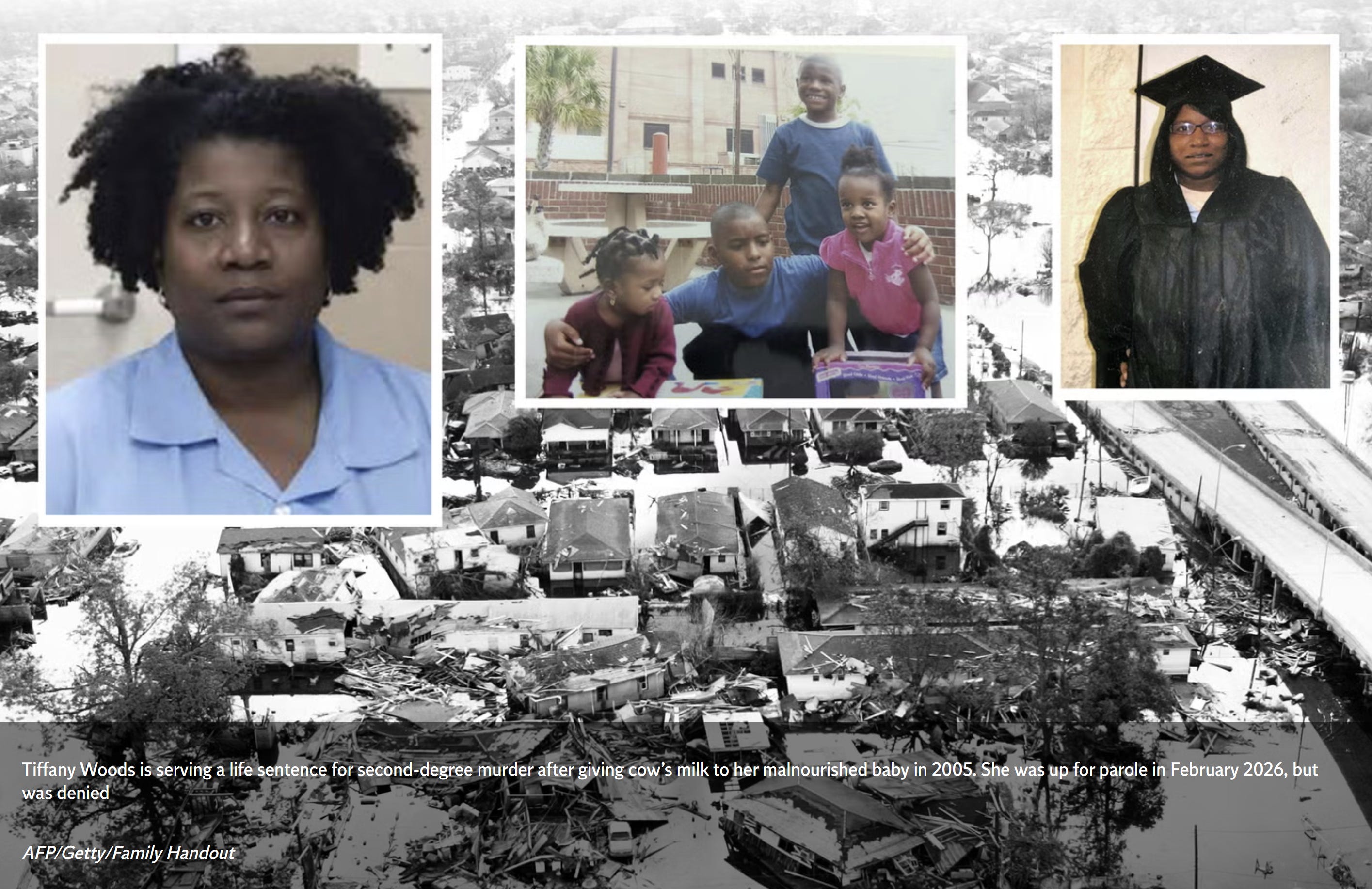
.
Louisiana’s legal system is unlike every other US state. It’s a civil law state, rooted in French and Spanish codes instead of English common law traditions everywhere else in the country.
In Louisiana, a second-degree murder conviction carries an automatic life sentence. In Baby Emmanuel’s case, the statute applied states:
“Second degree murder is the killing of a human being when the offender is engaged in the perpetration of cruelty to juveniles, even though he has no specific intent to kill or to inflict great bodily harm. Cruelty to a juvenile, as it relates to this matter, is defined as the intentional or criminally negligent mistreatment or neglect by anyone 17 years of age or older of any child under the age of 17, where by unjustifiable pain or suffering is caused to the child.”
At no point did any medical professional claim that baby Emmanuel, or Tiffany’s other children, were neglected. At no point did police feel abuse or neglect was a factor.
It’s hard to recall this case without sympathy for both parents. It’s hard to read about the grave injustice of their arrests and prosecution without getting angry.
And the racism — on the part of the system and the court — was evident early on.
Tiffany’s partner, Emmanuel Scott, had only a ninth-grade education and no GED. He was young, overwhelmed, and his entire life up-ended by the double hits of both his prematurely born son’s serious medical condition and Hurricane Katrina. He was exhausted, working up to 14 hours a day, perhaps inattentive, but not abusive.
The police referred to him as Tiffany’s “baby daddy” in their official report. They mentioned that the two had fought the night before, as if it was relevant. They began making their case against these two young, black refugees before the medical team stopped CPR.
Statements Tiffany made while still in shock that day were used against her — like her question to a social worker about whether or not baby Emmanuel was going to “die anyway” despite her efforts to provide for him, an obvious cry to be reassured that it wasn’t her fault.
Both parents opted for a bench trial without a jury. Both were found guilty by a white judge and sentenced to life in prison.
They appealed.
The appeals court sided with the original judge, outrageously claiming “neither defendant clearly and convincingly showed, under these facts, that unusual circumstances exist.”
They were chastised for not seeking medical intervention, despite the fact that Shreveport hospitals were so over-run in the months after Hurricane Katrina that it would take patients who showed up to the ER several days of waiting to be seen.
While they were living in shelters, a volunteer medical team member used her own insurance to take baby Emmanuel for a check-up, in which no new diagnosis or conditions were reported and the infant was still growing.
Tiffany also kept Emmanuel up-to-date with his vaccines, utilizing the Shots for Tots program in Shreveport after the storm.
They faulted Tiffany for “not keeping critical medical appointments” in reference to the appointment that fell on the same day that Hurricane Katrina hit Mississippi and shut down the hospital where the appointment was scheduled.
They faulted the mother for not having enough money to buy the formula, even though she needed and could not get a prescription for the special formula during the chaos of post-Katrina Louisiana.
Two weeks before Emmanuel died, Tiffany ran out of WIC vouchers, and during the post-Katrina social catastrophe, parish-based programs like WIC were in turmoil.
The heart and breathing monitor given to them by their doctor in New Orleans broke, and they were waiting for a replacement.
He had gained weight since being released from the hospital, and grew 11 centimeters, but that was not “sufficient” growth according the a judge with no medical training.
The court failed to meet its burden in finding the parents guilty.
And in doing so, they sent two parents to prison for life.
Tiffany told the court she tried her best, making sure she bought only organic milk for Emmanuel when the vouchers ran out. Back in 2005, organic milk cost nearly twice as much as non-organic milk, but still less than regular baby formula, and much less than specialized formula.
Sociopaths who don’t love their children don’t buy organic milk. They don’t wake up all hours of the night to feed their babies. They don’t keep up with vaccines and regular check-ups.
Their child was sick. He was on a feeding tube the first month of his life, displaced and living in shelters for the next few months, and still gained weight and grew despite all of those difficulties.
Police noted that the parents’ stories never changed, and the medical history supported their statements.
Tiffany and Emmanuel Sr. have been in jail ever since. It’s been 18 years.
While in prison, Tiffany completed seminary training and Blackstone Career Education courses for inmates studying paralegal work. She mentors and counsels other incarcerated women and has no disciplinary record.
The couple is eligible for sentence reduction once every five years.
Had I known about this case sooner, I would have been there to advocate at her last parole hearing this past February.
The prison staff, including the warden, testified on Tiffany’s behalf.
But DA Leone Fitzgerald, another white woman, in one of the most offensive statements I can imagine someone making, especially someone from the area, said her office was “getting a little tired of hearing about that (Hurricane Katrina) because, while we don’t undermine that, I know it had to be chaotic and stressful and unprecedented, but it wasn’t a reason for Miss Woods to not feed her baby.”
Tiffany’s parole plea was approved by two out of the three members of the Louisiana Board of Pardon and Parole. But the vote has to be unanimous, so her request plea denied.
Tiffany won’t be eligible for parole again until 2031. Next time, I’ll be there. And I hope all of you reading this will write to the board or be there, too.
Here’s who you can write/call:
Caddo Parish District Attorney’s office
501 Texas St #5400, Shreveport, LA 71101
318-226-6826
Louisiana Board of Pardons and Committee on Parole
603 South Blvd, Baton Rouge, LA 70802
225-342-6622
Send mail/support to Tiffany:
Tiffany M. Woods
Louisiana Correctional Institute for Women
6923 Highway 74, St. Gabriel, LA 70776
Send money to her here
Prison phone number: (225) 319-2701
Don't know what to say, Rebekah, other than it's a heartbreaking story told very poignantly by you, a gifted writer and reporter. The prejudice shown towards Blacks by Louisiana officials doesn't surprise me at all. I would have thought, though, that they could at least cut Blacks a little slack following the horror and devastation of Katrina. Getting a routine prescription filled was nearly improssible following Katrina. Magify the difficlulty a hundred times if you need to find a specialty doctor to write a speciality prescription and locate a pharmacy to fill it. Lousiana is know for the inhumane way it treats its prisioners, especially Black prisioners. Its prisons and jails are the worst in the country. I think it's about time for you to think about running for office somewhere. You would make a tremendous Congresswoman.
Well, I don't know about a "thanks for this" Rebekah, because it makes me ill. I was a teacher in Texas during this time, and we took in so many children. No records of any kind, but we took them in and as a community we cared. I am trying to access the link to at least give her some monetary assistance. I will keep trying until I can make it work. Glad you were able to get the word out on this. So glad I subscribe.