Trump regime revives "Got Milk?" campaign
Another white-supremacist-aligned messaging blitz
In a single, poorly-photoshopped post to Xitter, the U.S. Department of Agriculture appears to have resurrected one of the most infamous and misleading campaigns in American marketing history: “Got Milk?” — a dairy-industry ad campaign that was effectively retired over a decade ago.
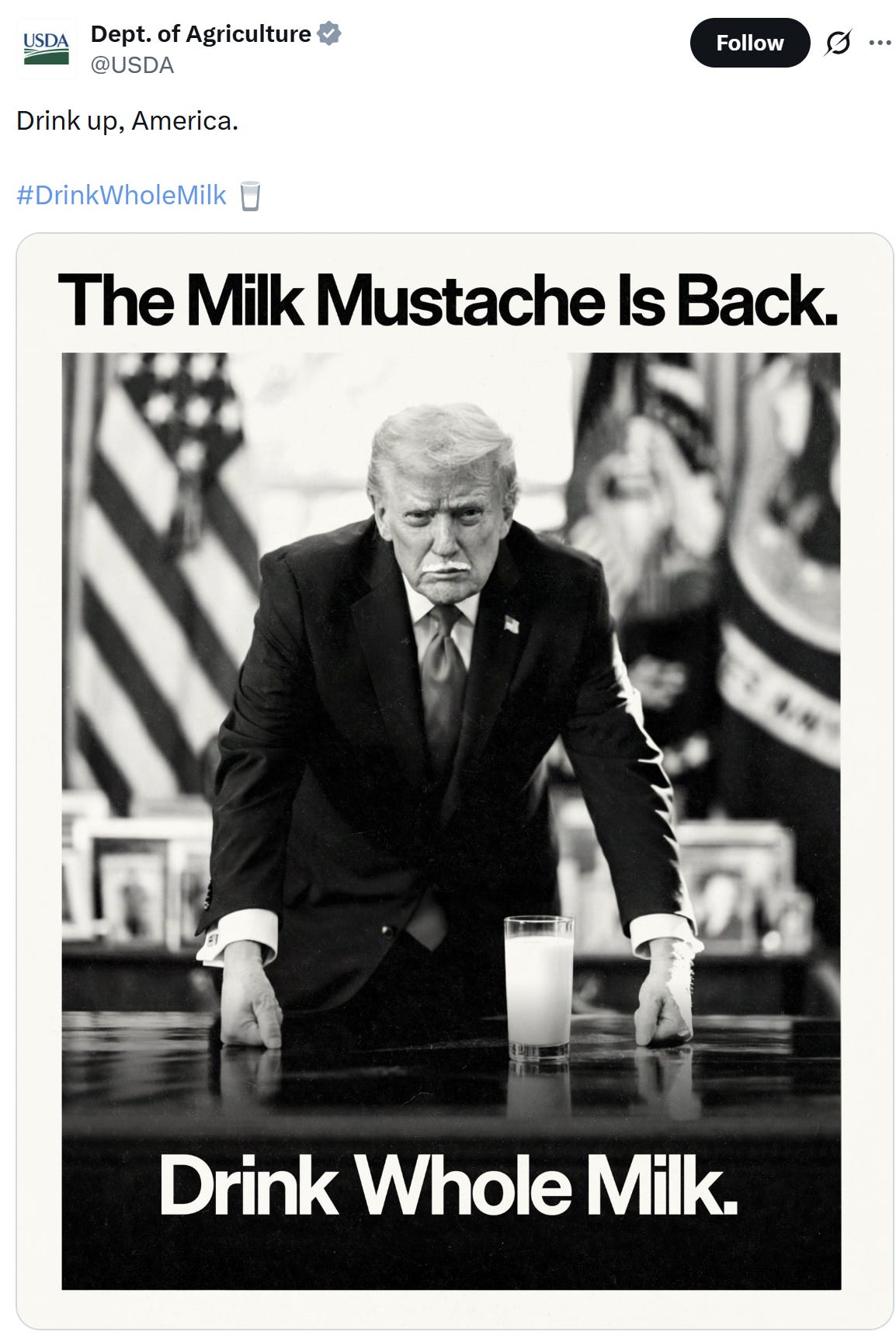
Originally launched in 1993 and funded through industry checkoff programs — assessments on commodity producers that collectively underwrote generic advertising like “Got Milk?” and “Pork — The Other White Meat” — the campaign was never a USDA public-health initiative but a marketing program serving corporate interests. Checkoff programs themselves have been controversial precisely because they obligate farmers and producers to fund promotional messaging with broad public visibility.
That said, the cultural afterlife of “Got Milk?” was outsized. Its commercials — including one of its earliest spots directed by Michael Bay — plastered celebrities and athletes with iconic milk mustaches and staked exaggerated health claims to a product that, for many Americans, isn’t even a necessary or beneficial staple.
Here’s why that matters:
1. Scientific Evidence Doesn’t Support Broad Health Claims
For decades, dairy advocates marketed milk as essential to bone strength and overall health, but contemporary nutrition science is far more nuanced. While dairy provides calcium and vitamin D (nutrients many Americans do need), major health organizations do not endorse milk as a health panacea, and solid evidence linking dairy intake to improved long-term health outcomes is mixed at best. According to the UK’s Cancer Research and the British Dietetic Association, there’s no reliable evidence that dairy consumption causes cancer — yet neither is there definitive proof that it prevents it.
2. Dietary Fat and Cardiovascular Risk Are Complex
Whole milk, cheese, and butter contain saturated fat — a nutrient historically associated with elevated LDL cholesterol and cardiovascular risk. Recent analyses have shown that not all saturated fats are equal and that dairy’s unique fatty acid profile complicates simple narratives about its cardiovascular impact. Institutional dietary guidance (e.g., the USDA’s Dietary Guidelines for Americans) continues to recommend low-fat or fat-free dairy for children and adults alike as part of an overall healthy pattern, and does NOT promote whole milk.
3. The Original Campaign Was Industry Marketing, Not Public Health
Though the USDA didn’t create the original “Got Milk?” ads, the agency’s willingness to recycle the imagery now — whether intentionally or through some ill-advised social-media post — is striking. The campaign’s historical aim was to boost dairy consumption during periods of oversupply and to cultivate cultural attachment to milk at a time when consumer behavior was already shifting.
In recent years, milk consumption has declined in the U.S., even before this apparent revival of old ad slogans — driven by rising awareness of lactose intolerance, ethical concerns about animal agriculture, and the availability of plant-based alternatives.
And lastly: High Lactose Intolerance Prevalence
A striking and often overlooked reality is that lactose intolerance — the inability to properly digest the sugar lactose found in milk — affects a majority of the world’s population.
Estimates suggest that roughly 65% of people globally have reduced ability to digest lactose after infancy, and that rates are significantly higher among Indigenous, Black, and Asian populations in the U.S. than among white populations.
This isn’t just a quirk of digestion — it’s a lived experience for tens of millions of Americans who literally cannot tolerate the product being touted as a universal health food. Any message that assumes milk is “good for everyone” ignores this demographic reality.
It’s one thing for Big Dairy to recycle nostalgic marketing; it’s another for a federal agency — whose mission should center on public health, food safety, and nutrition science — to appear to borrow from an advertising campaign steeped in corporate interests and outdated health claims.
Government communication should be rooted in evidence and equity, not retro ad slogans that ignore the lived realities of large segments of the population.
Activists and analysts have been warning for years about the ways government messaging can be used to obscure industry influence, sanitize corporate narratives, and even echo exclusionary cultural tropes. When those messages veer into nostalgia for “simple” products like milk — without acknowledging systemic inequities or genuine public-health context — they do a disservice to public trust.
The resurgence of “Got Milk?” — even as a meme — isn’t just bad marketing. It’s a reminder that public institutions must be careful not to amplify industry propaganda under the guise of public communication — especially when so many Americans, particularly people of color, have been historically sidelined in both dietary science and agricultural policy.
When “Nutrition Messaging” Becomes a Dog Whistle
It would be a mistake to treat the revival of “Got Milk?” as merely tone-deaf nostalgia or a lazy social-media post. Context matters. So does pattern recognition.
For decades, political scientists and historians have documented how seemingly neutral cultural symbols — food, “tradition,” patriotism, rural imagery — are routinely weaponized to signal racial hierarchy without explicitly naming it. This is the core mechanism of what Ian Haney López famously described as dog-whistle politics: coded appeals that activate racial resentment while preserving plausible deniability.
Milk, in particular, occupies a strange and well-documented place in that history.
Lactase persistence—the genetic ability to digest lactose into adulthood— is most common among people of Northern European descent and far less common among Black, Indigenous, Asian, and Latino populations.
That biological reality has long been used- explicitly in early 20th-century eugenics literature and implicitly in modern culture — to frame milk consumption as normal, healthy, and civilized, while casting those who cannot tolerate it as deficient or aberrant. This was a particularly nasty approach within my own field (geography) under Friedrich Ratzel at the turn of the 20th century.
That framing did not disappear; it was simply laundered through advertising.
When a federal agency amplifies a dairy-industry slogan without acknowledging that over one-third of Americans — and a majority of non-white Americans— are lactose intolerant, it reinforces a default image of who public policy is for. Who is assumed. Who is centered. And who is expected to adapt or disappear.
This is not speculation. Public-health scholars have repeatedly warned that U.S. dietary guidelines and food-promotion campaigns have historically privileged white, Eurocentric dietary patterns while marginalizing others, often under the guise of “science-based recommendations.” The result is policy that appears universal but functions as exclusionary in practice.
Government Accounts Are Not Neutral Megaphones
The deeper problem is not milk. It is the misuse of government communication channels to launder ideology as normalcy.
Since the White House reasserted aggressive control over federal agency messaging, official social-media accounts have increasingly adopted aesthetics and narratives that mirror far-right cultural politics: nostalgic imagery, “heritage” language, AI-generated pastoral scenes, and repeated invocations of “protecting the homeland.”
Scholars of extremism have noted that these tropes are not accidental— they are among the most common visual and linguistic signals used in contemporary white-nationalist propaganda precisely because they sound benign to outsiders.
Sometimes the overlap is subtle. Sometimes it is not.
The repeated borrowing of imagery that echoes 1930s and 1940s European propaganda — idealized bodies, rural purity, ethnically homogenous crowds — has been extensively cataloged by researchers tracking online radicalization.
When those aesthetics appear on official government accounts, the effect is profoundly different from when they appear on a fringe message board. The state confers legitimacy. It normalizes the signal.
This is how ideology spreads without ever being argued.
The Point Isn’t Milk — It’s Power
No one is being forced to drink a glass of whole milk. That’s not the claim. The claim is far more serious.
When the federal government resurrects a discredited industry campaign, ignores well-established health and demographic realities, and deploys culturally loaded symbols that align neatly with exclusionary politics, it is not communicating nutrition advice. It is asserting a vision of who “real Americans” are supposed to be — and doing so through the machinery of the state.
History tells us where that road leads.
Authoritarian movements rarely begin with explicit declarations of racial supremacy. They begin with myth-making, with nostalgia, with the quiet insistence that the nation has a single “normal” culture and that everyone else is a deviation. Food. Flags. Farms. Milk. These are not trivial choices; they are among the oldest tools of nationalist storytelling.
The danger is not that a government agency posted a bad graphic. The danger is that public institutions are being repurposed to rehearse a narrower, whiter version of America—one post at a time.
And once the state decides who belongs culturally, deciding who belongs politically—or at all—becomes much easier.


