

Some housekeeping:
If you missed Monday’s episode of The Barometer, I’ve got the highlights for you in this story, but you can view the full, unedited video here on Youtube. Please pardon the first moments as I was having issues with my mic that are quickly sorted out.
But FIRST! Lessons learned.
Monday at 7 am is too early of a start time, and my house is too busy to keep the promise that I’ll be here weekly on that day. I have more help on Tuesday morning and, as such, I’m moving the permanent air time of the show to Tuesdays from 8 am - 10 am.
So mark your calendars!
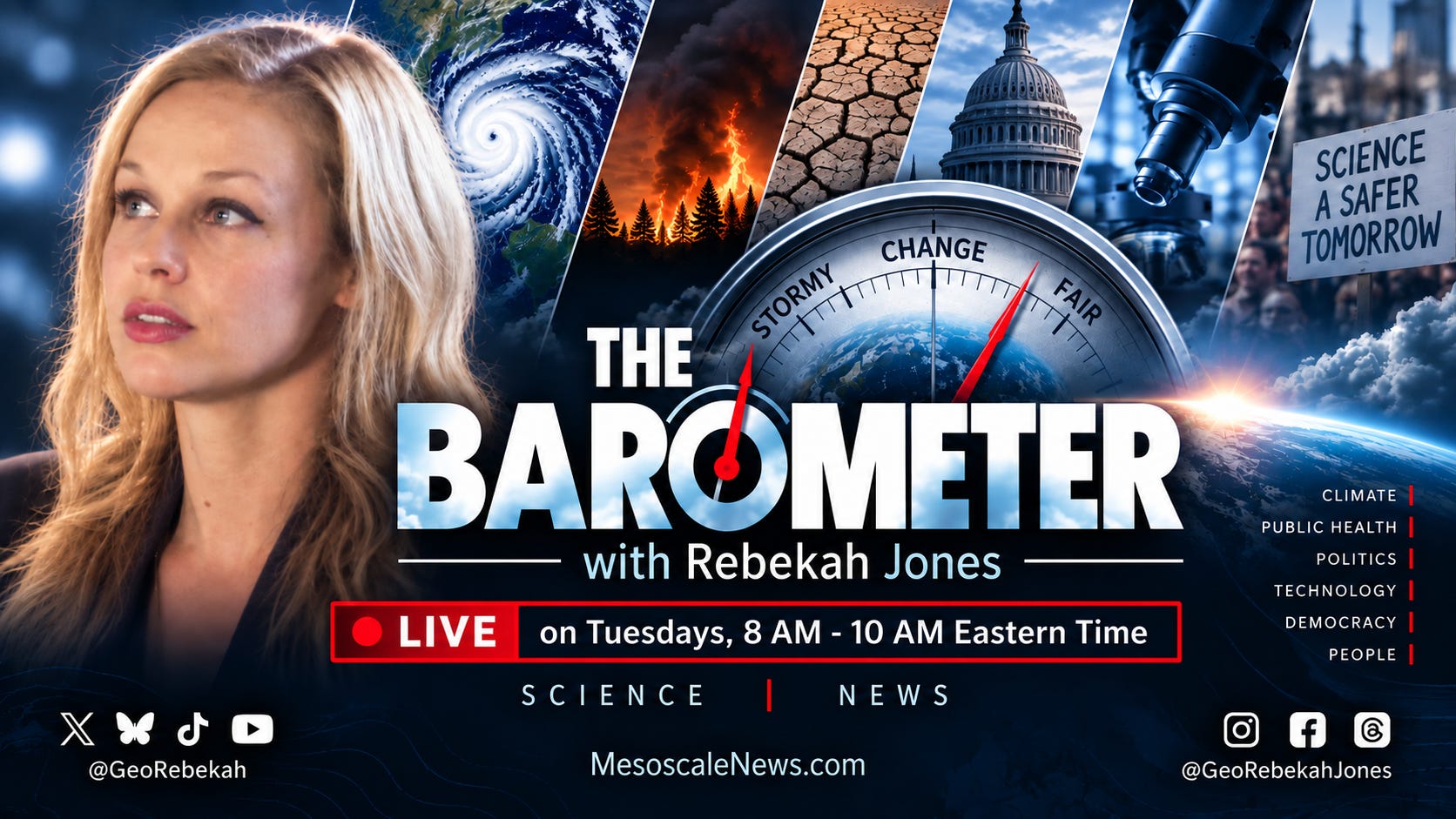
The first episode of The Barometer followed one question through politics, climate, public health and geography: What happens when powerful institutions manipulate the information people use to keep themselves safe?
The Barometer is a new live Tuesday-morning broadcast from Mesoscale News, airing from 8–10 a.m. Eastern.
Yesterday morning, I opened the first episode of The Barometer with a reading from Mauna Loa: the amount of carbon dioxide accumulating in the atmosphere we all share.
That number is more than a scientific ritual. It is the baseline pressure reading for a planet being pushed into conditions no human civilization has experienced. But the atmosphere was not the only pressure system moving this week.
Donald Trump promised Americans $5,000 (again) but only if Republicans maintain control over both branches of Congress. A rapidly intensifying El Niño is rearranging weather patterns across the globe. A mistrial in Massachusetts exposed disturbing questions about the lone holdout juror. Newly released documents shed more light on what New York City knew about the poisoned air after September 11. And the United Nations finally confronted one of the most familiar geographic lies ever printed: the Mercator world map.
These stories may seem unrelated. They are not.
Each is about information: who controls it, who distorts it, who gets excluded from it, and what happens when people make consequential decisions based on what they have been told.
Trump’s latest check is in the mail — again
At the Republican midterm convention last week, Donald Trump promised to issue a $5,000 “Trump dividend” to every adult citizen if Republicans retain control of both the House and Senate in November.
The condition was not subtle: If Republicans win, you win with us and you get $5,000.
The promise collapses quickly under arithmetic.
Five thousand dollars for approximately 240 million adult citizens would cost about $1.2 trillion. The federal government has not collected anything close to that amount in tariff revenue. The Congressional Budget Office estimated tariff collections of about $167 billion during the current fiscal year, which is less than one-seventh of what the checks would require.
Nor can a president simply order the Treasury to distribute more than a trillion dollars. Congress controls federal spending. Even House Speaker Mike Johnson acknowledged that lawmakers would have to authorize the proposal.
There is no enacted law. There is no funded program. There are no eligibility rules, payment dates or applications. There is only a campaign promise tied directly to an election result.
Trump has used this trick before. He floated $5,000 checks from supposed DOGE savings. He later promised $2,000 tariff dividends. Neither arrived. His $1,776 “warrior dividend” for service members was not funded by magical new revenue; it repurposed money Congress had already approved for military housing.
The political pitch is almost impressively shameless: Republicans already control the White House and both chambers of Congress, but Americans must return that same party to power before it can supposedly do something it has not done while already holding power.
This is not a check. It is a slogan with a dollar sign.
A potentially historic El Niño is taking shape
While politicians invented money, the Pacific Ocean was moving very real heat.
NOAA’s Climate Prediction Center now says El Niño is strengthening, with a greater than 90% chance of becoming a very strong event during the Northern Hemisphere fall and winter. If the upper range of the forecast verifies, it could rival or exceed the strongest El Niño events in the instrumental record.
El Niño is not a storm. It is the warm phase of a vast ocean-atmosphere cycle centered in the tropical Pacific. When that enormous band of water becomes unusually warm, it changes atmospheric circulation around the world. It shifts jet streams, redistributes rainfall, alters hurricane environments and adds another pulse of heat to the global climate system.
For the United States, the seasonal outlook generally favors warmer conditions across much of the country, with the strongest temperature anomalies expected in Alaska and the Pacific Northwest. The northern tier is more likely to be dry, while the Southeast and Four Corners may receive more precipitation.
Those are probabilities across an entire season, not a guarantee that every day in Seattle will be warm or every week in Florida will be wet. El Niño loads the atmospheric dice. It does not dictate every roll.
This year, it is also helping create a startling split between ocean basins. The Pacific has produced a barrage of storms near Hawaiʻi, while the Atlantic reached the climatological peak of hurricane season without producing a hurricane. Increased upper-level wind shear associated with El Niño is one likely contributor to that suppression.
But an inactive basin is not the same as a harmless one. A single late-season storm can still define the year for every person in its path.
And this El Niño is developing on top of a climate already heated by decades of greenhouse-gas pollution. The ocean pattern is natural. The furnace underneath it is not.
Eleven jurors agreed. The twelfth became the story.
The murder trial of Lindsay Clancy ended in a mistrial after more than six days of deliberations. Eleven jurors reportedly favored finding her not guilty by reason of insanity. One refused.
Clancy was accused of killing her three children during what her defense described as a severe postpartum psychotic episode.
After the mistrial, several jurors described the lone holdout as disengaged, arrogant, dismissive of the judge’s instructions, and unwilling to apply reasonable doubt as the judge instructed. One said he attempted to re-create the killings using a water bottle and exercise bands.
Then NBC10 Boston uncovered details from his past.
Court records reviewed by the station showed that the juror had faced arrests and domestic-violence charges involving his former wife. NBC10 also reported an active restraining order involving a thirteen-year-old family member, and a separate unresolved housing case.
These revalations raise a legitimate institutional question: What did the juror disclose during voir dire, and did the selection process provide the court and attorneys with the information they needed to evaluate whether he could deliberate impartially in a case involving strangulation and mental illness?
Prosecutors have not announced whether they will retry Clancy. A status hearing is scheduled for September 29. A hung jury generally permits a new trial, although the defense may still make case-specific arguments for dismissal.
The online debate has tried to transform the case into a referendum on one mother, one juror, or postpartum mental illness itself. The legal question is narrower, and the human tragedy is larger: three children are dead, a family is destroyed, and a system tasked with delivering a lawful verdict failed to reach one.
The air was not safe—and saying it was changed what people did
Twenty-five years after September 11, New York City began releasing approximately 170,000 pages of records concerning air quality, health and the government’s response after the attacks. You can access those files here.
The release reportedly includes the Harding Memo, records recovered from sixty-eight boxes that officials had previously said they could not locate, and documents concerning 7 World Trade Center. Additional material is expected over the coming year.


We have long known that the World Trade Center dust contained a dangerous mixture of pulverized concrete, glass fibers, asbestos, metals and combustion products. We have watched responders, cleanup workers, residents and office workers develop respiratory diseases, cancers and other chronic conditions.
The new release adds documentary detail about the space between what officials discussed privately and what the public was told—and about the degree to which potential legal liability influenced the response.
That gap matters because telling people “the air is safe” is not neutral information.
It changes behavior.
People return to apartments. Parents send children back to school. Workers remove respirators. Windows open. Contaminated dust is disturbed and inhaled again. Public communication becomes part of the exposure pathway.
Officials inevitably speak before every sample has been analyzed and every risk quantified. Uncertainty is unavoidable. Dishonesty is not. When evidence is incomplete, the scientifically responsible statement is we do not yet know—not a reassurance the available evidence cannot support.
The people easiest to lose were those who did not fit the iconic image of a Ground Zero responder: residents, office workers, students and children. Roughly 25,000 children lived or attended school in Lower Manhattan on September 11. A major long-term study focused on people exposed as children is only now beginning. Those children are adults. The government is a quarter-century late in systematically asking what happened to them.
Releasing records is necessary, but a document portal is not restitution. Transparency has to lead somewhere: active outreach, healthcare, research, enrollment in the World Trade Center Health Program, compensation where appropriate, and institutional reforms that protect people during the next disaster.
The next official who stands before an anxious public and claims the air is safe should feel the weight of these records behind every word.
The world map most Americans know is not telling the truth
The United Nations General Assembly recently approved a resolution adopting wider use of equal-area world maps, specifically the Equal Earth projection, challenging the continued use of projections that grossly distort relative area when area is precisely what the map purports to show.
The Mercator projection was developed in the sixteenth century for navigation. It preserves local angles, allowing sailors to plot constant compass bearings as straight lines. For that purpose, it was ingenious.
As a general map of the world, it is deeply misleading.
Mercator inflates land near the poles and diminishes land near the equator. Greenland appears roughly comparable to Africa, even though Africa is about 14 times larger. Europe and North America loom; Africa and South America recede.
That is not a harmless aesthetic choice. Maps teach hierarchy before anyone reads a label. A projection that enlarges former colonial powers while shrinking much of the colonized world can make political history look like physical geography.
Equal Earth preserves relative area far more faithfully while retaining a readable, familiar-looking shape. It still distorts other properties, because every flat map must. There is no perfect way to press a sphere onto a rectangle without stretching, compressing or tearing something.
Every map is an argument. Someone chose its center, boundaries, scale, colors, labels, data and projection. The honest question is not whether a map makes choices. It is whether those choices serve its purpose, and whether the viewer understands what they hide.
The common pressure system
The first episode of The Barometer moved from a campaign stage to the tropical Pacific, from a Massachusetts courtroom to the dust of Lower Manhattan, and finally to the mathematics of flattening a planet.
The same pressure ran through every story.
Information is a public-safety system. When it works, people can prepare, decide and protect themselves. When it is distorted, delayed or hidden, the consequences escape the screen. They enter voting booths, courtrooms, classrooms, homes and lungs.
The Trump promise asks voters to mistake a condition for a commitment. The El Niño forecast asks the public to understand probability without dismissing danger. The Clancy mistrial asks whether the machinery of justice gathered the information it needed. The 9/11 records show how official certainty can increase exposure. The UN resolution reminds us that even the shape of the world we carry in our heads was produced by choices.
Facts are not self-executing. They require institutions willing to collect them, journalists willing to interrogate them and a public unwilling to accept confidence as a substitute for proof.
The pressure is rising. The question is whether the instruments are telling the truth.
I hope you will join me next Tuesday at 8:00 AM for our second episode.
Watch the full episode of The Barometer here. New episodes stream Tuesdays from 8–10 a.m. Eastern.
Paid subscriptions make this independent reporting—and the work required to turn a three-hour live broadcast into accessible clips and analysis—possible.
If you value independent science and accountability journalism, become a paid subscriber to Mesoscale News. The next disaster will not wait for the truth to become convenient.