The New Normal Is $115 Billion a Year
2025 clocks in as the third-most expensive year for billion-dollar weather disasters
There’s a temptation when talking about climate change to treat the numbers as abstract. Trillions of dollars. Dozens of disasters. Records broken again. The language starts to blur, and the human reality slips out of focus.
So let’s sharpen it.
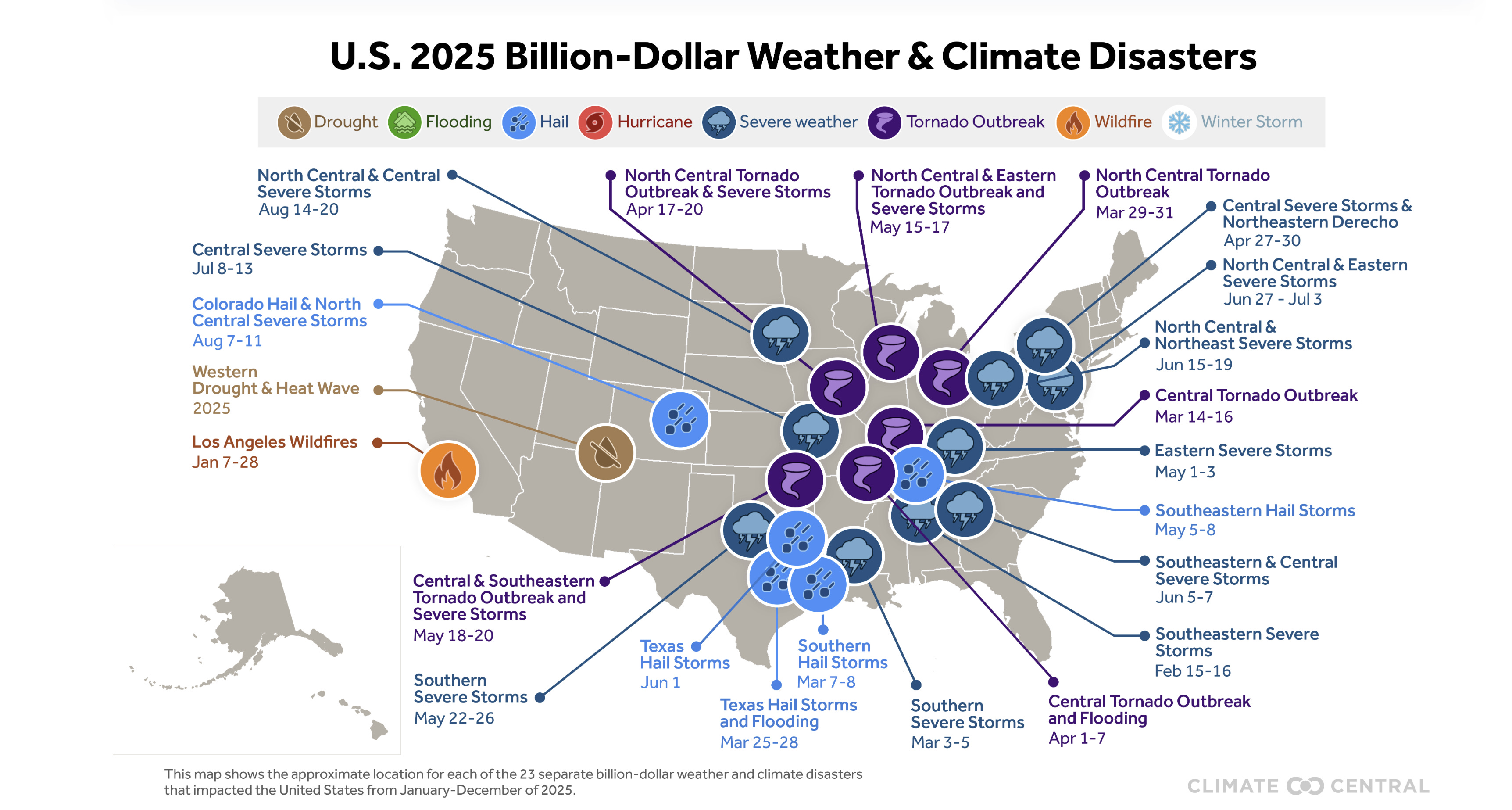
According to Climate Central, 2025 ranked as the third-highest year on record for billion-dollar weather and climate disasters in the United States, trailing only 2023 and 2024. In just twelve months, the country absorbed 23 separate disasters, together costing $115 billion.
That’s not a projection. That’s not a worst-case scenario. That’s the bill we’ve already been handed.
And as always, the headline numbers only tell part of the story.
A Firestorm With a Price Tag We’ve Never Seen Before
The single costliest disaster of 2025 wasn’t a hurricane or a flood. It was fire.
The January 2025 Los Angeles wildfires shattered records, becoming the most expensive wildfire in U.S. history, with $61.2 billion in damages — roughly twice as costly as the previous record holder. Entire neighborhoods were erased. Infrastructure burned. Insurance markets strained to the breaking point.
Wildfires used to be seasonal events. Then they became annual crises. Now they’re winter disasters too.
Los Angeles didn’t just experience a bad fire year — it crossed into a new financial and physical reality where fire behaves less like a natural hazard and more like a systemic threat. When fires cost tens of billions of dollars in a single metro area, we’re no longer talking about “recovery.” We’re talking about permanent economic injury.
Severe Weather, Everywhere, All at Once
While wildfires dominated the price tag, severe weather dominated the map.
In 2025, severe storms and tornado outbreaks accounted for a record 21 separate billion-dollar disasters, concentrated across the central United States during the spring and summer months. These weren’t isolated supercells or one-off outbreaks. They were clusters, storm after storm tearing through the same regions with little time to rebuild in between.
This is one of the most under-discussed shifts in the climate era: disaster compounding.
Communities aren’t just hit harder; they’re hit again before the first damage is even repaired. Roofs replaced in April are ripped off again in June. Emergency funds are exhausted early. Insurance deductibles stack. Local governments fall behind, permanently.
For the people living there, the experience is less “weather event” and more continuous instability.
The Long View: $3.1 Trillion and Counting
Zoom out further, and the pattern becomes impossible to ignore.
Since 1980, the United States has endured 426 billion-dollar weather and climate disasters, with total costs exceeding $3.1 trillion. Adjusted for inflation, that figure represents one of the largest wealth transfers in modern American history — from households and communities to rebuilding costs, emergency response, and insurance payouts.
What’s changed since 1980 isn’t just the weather. It’s exposure.
There are more people, more homes, more businesses, and more infrastructure sitting directly in harm’s way. Combine that with a climate system that now routinely produces stronger storms, heavier rainfall, more intense heat, and longer fire seasons, and the math becomes brutal.
More extremes. More targets. Bigger losses.
This Is What Climate Change Looks Like in Dollars and Lives
It’s important to say this plainly: the surge in billion-dollar disasters is not a statistical trick, and it’s not just inflation doing the work.
Yes, development patterns matter. Yes, coastal and inland growth increases exposure. But those factors alone cannot explain the acceleration we’re seeing over the past decade — especially the back-to-back-to-back record years of the 2020s.
What we’re witnessing is climate change expressing itself through economics.
Every destroyed home, every flooded business district, every burned power substation carries a price tag, and those price tags are rising because the physical limits we once relied on are no longer holding.
Storms stall where they used to move. Heat builds where it used to break. Fires ignite in months that used to be safe.
The Reckoning Ahead
The most dangerous lie we still tell ourselves is that this pace is sustainable - that we can just keep rebuilding, reinsuring, and reacting our way out of the problem.
We can’t.
A country that absorbs more than $100 billion in disaster losses year after year is a country quietly draining its future. The costs don’t disappear; they show up in higher insurance premiums, shrinking housing availability, stressed municipal budgets, and widening inequality between those who can afford to recover and those who can’t.
The numbers from 2025 aren’t just a summary of the past year. They’re a warning label for the decade ahead.
Climate change is no longer a future risk. It’s a recurring expense—one we’re paying whether we acknowledge it or not.
And the bill is coming due faster every year.


If there was easy money to be made in dealing with climate change, the current grifters leading our govt would be all over it. The small minded guy in charge has zero understanding of science or economics. Saving our planet will (obviously) be beneficial for everyone, but it takes time and vision and commitment. Not attributes these guys possess.