
The Department of Defense Turns Its Eye Towards Americans

If you value deeply researched reporting on democracy, civil liberties, climate, public health, authoritarianism, and the systems shaping our lives, consider becoming a paid subscriber to support this work at MesoscaleNews.com.

The most dangerous thing about the 2026 National Defense Strategy is not simply that it is militaristic. Defense strategies are supposed to be about the military.
The danger is that this one borrows the grammar of democratic collapse.
It opens with a story of national humiliation and betrayal: America’s borders were “overrun,” its leaders forgot the Monroe Doctrine, its warfighters were condemned, its allies became dependents, and only Donald Trump’s return restored clarity, strength and purpose.
In the introduction, the document frames the Department of War [Sic] as an instrument to be wielded at the president’s direction, in service of his vision, his strategy and his promised restoration of American greatness. That is not normal Pentagon language. It is leader-centered doctrine.
Previous defense strategies talked about alliances, deterrence, democratic values and the so-called rules-based order. This one talks about homeland defense, hemispheric control, border militarization, “warrior ethos,” industrial revival, and restoring American military dominance.
The 2026 strategy explicitly prioritizes securing borders and maritime approaches, guaranteeing U.S. military and commercial access to the Panama Canal, Greenland, and the “Gulf of America,” and providing the president with “credible military options” against “narco-terrorists.”
That language matters because authoritarianism does not begin with a formal declaration that democracy is over. It begins by changing what the state says it is defending, who it says it is defending against, and what kinds of power it claims are necessary to survive.
The 2026 strategy does all three.
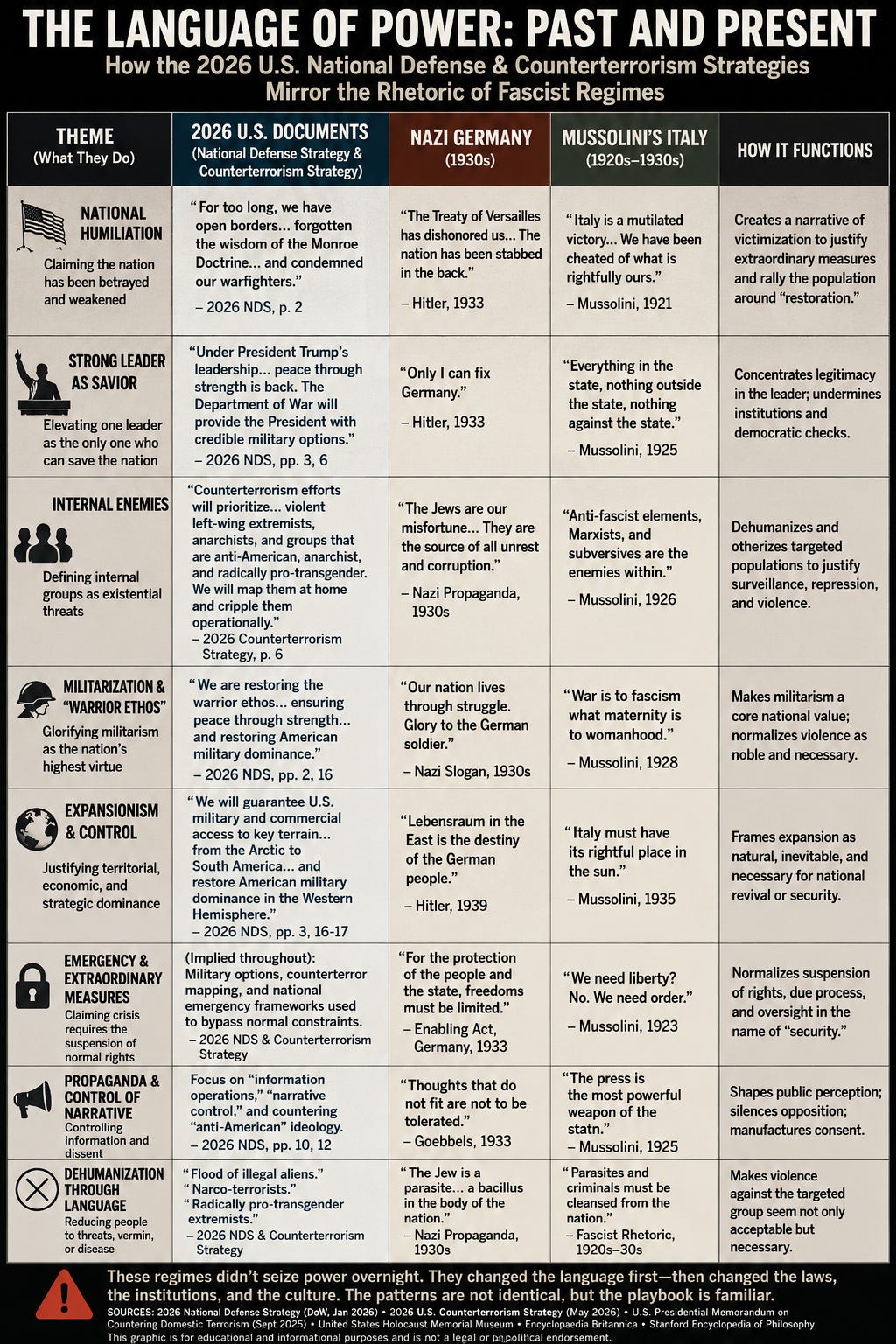
It fuses migration, narcotics, terrorism, borders, foreign policy, trade routes and military force into one homeland-security framework.
In the “Homeland and Hemisphere” section, the strategy employs false narratives about how the United States has been overwhelmed by illegal migration, that narcotics have poured across the border, and that traffickers in the hemisphere are properly treated as foreign terrorist organizations. It then uses that frame to justify military operations and broader executive flexibility.
That is how civil liberties begin to shrink. Not all at once. Not honestly. Not with a memo titled “We Are Suspending Rights Now.”
It happens when civilian problems become war problems. When migration becomes invasion. When protest becomes terrorism. When advocacy becomes extremism. When an identity becomes a threat category.
The administration’s 2026 Counterterrorism Strategy makes explicit what the defense strategy implies.
It identifies three major terror categories: narcoterrorists and gangs, legacy Islamist terrorists, and “violent left-wing extremists,” including anarchists and antifascists.
It then says national counterterrorism activity will prioritize groups described as anti-American, anarchist and “radically pro-transgender,” and promises to “map them at home” and use law enforcement tools to “cripple them operationally.”
That sentence should stop everyone cold.
The document does not merely identify violence. It identifies ideology. “Radically pro-transgender” is treated not as speech, civil-rights advocacy, identity defense, medical autonomy or political organizing, but as a national-security marker.
That is a profound human-rights danger because the available evidence does not show that transgender and nonbinary Americans pose a disproportionate violence threat. It shows the opposite.
“We are restoring the warrior ethos… ensuring peace through strength… and restoring American military dominance.”
2026 NDS, Pages 2, 16
The Bureau of Justice Statistics found that from 2017 to 2020, transgender people experienced violent victimization at 51.5 victimizations per 1,000 people, compared with 20.5 per 1,000 among cisgender people — a rate 2.5 times higher.
A Williams Institute study using earlier National Crime Victimization Survey data found transgender people experienced 86.2 violent victimizations per 1,000 people, compared with 21.7 per 1,000 for cisgender people. More recent Williams Institute analysis found LGBT people are five times more likely than non-LGBT people to be victims of violent crime and nine times more likely to experience violent hate crimes.
Meanwhile, extremism and mass-violence experts told PolitiFact they found no evidence of rising “trans terrorism” or widespread violent radicalization among transgender people. PolitiFact also found that even if every mass-shooting case cited in anti-trans social media claims were counted as transgender-related, they would represent only a tiny fraction of mass shootings during the period examined.
So the state is not responding to a demonstrated wave of transgender violence.
It is taking one of the country’s most violently targeted populations and re-coding them as a security threat.
That is exactly the kind of inversion that appears again and again in societies sliding toward authoritarian rule: the vulnerable are described as dangerous, the state describes its own expansion of power as protection, and the public is asked to fear the people most likely to need protection from the state.
The Lemkin Institute for Genocide Prevention has warned that the United States is in what it calls the early-to-middle stages of a genocidal process against trans people, centered not only on physical violence but on erasure from public life, law, medicine, education and recognition. This is a genocide-prevention warning from scholars and experts whose work is to identify patterns before mass atrocity becomes undeniable.
And the pattern they describe is visible here: denial of identity, destruction of support structures, criminalization of care, and then national-security language that turns defenders of transgender life into extremists.
The same inward-facing machinery is being aimed at liberal and leftist groups.
A September 2025 presidential memorandum on domestic terrorism claims political violence is tied to “anti-fascism” and lists anti-Americanism, anti-capitalism, anti-Christianity, migration, race and gender as common ideological threads. The memo directs Joint Terrorism Task Forces to investigate not only individuals accused of violence, but also funders, nonprofit organizations, officers, employees, financial networks, tax-exempt entities and Americans abroad who may be connected to alleged domestic-terror networks.
That is not narrow counterterrorism. That is a blueprint for surveillance of political ecosystems.
All of this is unfolding against a backdrop of escalating violence and terrorism threats tied to white supremacist and far-right extremist movements — groups the FBI, DHS, counterterrorism researchers, and multiple national security experts have repeatedly described as among the most persistent, lethal, and significant domestic threats facing the United States.
Authoritarian governments almost always claim they are only targeting violence, corruption, extremism or disorder – but only ever against those who challenge or criticize them.
Freedom House has documented how modern authoritarian systems often attack civil society first, especially organizations involved in human rights, democratic reform and anticorruption work.
V-Dem’s 2026 Democracy Report found that repression of civil society now affects most autocratizing countries, while media censorship remains the most common tactic among governments moving toward autocracy.
That is the context in which these documents should be read.
Not as isolated bureaucratic plans.
As a sequence.
The defense strategy supplies the atmosphere: national humiliation, border invasion, hemispheric enemies, restored military dominance, a leader’s vision, and a Department of War ready to act with “speed, power, and precision.”
The counterterrorism strategy supplies the targets: left-wing activists, anarchists, antifascists, pro-trans movements and allegedly anti-American political networks.
The domestic-terror memorandum supplies the machinery: JTTFs, financial investigations, IRS scrutiny, nonprofit targeting, interrogations, domestic-terror designations and organized-crime-style network disruption.
This is how states turn inward.
Not with one law. Not with one speech. Not with one dramatic rupture.
With categories.
With language.
With maps.
With lists.
With “threat assessments.”
With people who were already vulnerable being described as dangerous enough to justify extraordinary force.
The warning here is not that the United States has already become Nazi Germany or fascist Italy. History does not repeat that neatly, and lazy comparisons make it easier for people to dismiss real danger.
The warning is more precise: the language now appearing in U.S. national-security doctrine resembles the language scholars identify in democratic backsliding and authoritarian consolidation — leader worship, internal enemies, militarized nationalism, attacks on civil society, ideological policing, and the conversion of minority rights into security threats.
And once a government teaches its agencies to see transgender Americans, immigrants, leftists, antifascists, educators, nonprofits and civil-rights organizers as part of the same domestic-threat environment, the question is no longer whether rights are at risk.
The question is how much machinery has already been built before the public understands what it is for.
The most dangerous political transformations rarely arrive all at once.
They arrive through paperwork.
Through policy language.
Through “emergency powers.”
Through new threat categories.
Through people being taught to fear one another.
By the time history recognizes authoritarianism clearly, the machinery is usually already built.
That’s why independent reporting matters now — while these documents are still being written, normalized, and expanded.
If you want journalism that reads the source material, follows the data, and connects today’s policies to the lessons history already taught us, support independent reporting at MesoscaleNews.com by subscribing and sharing this piece.