
Reporting from Capitol Hill Ocean Week (CHOW 2026)

A note to Mesoscale’s readers:
The future of science policy is increasingly being shaped by people who neither practice science nor appear particularly interested in it.
At Mesoscale News, I travel directly to conferences, hearings, communities, and disaster zones to document what is actually happening — not what officials say is happening. That means sitting through the speeches, asking uncomfortable questions, interviewing the experts being pushed aside, and reporting what larger outlets often miss.
If you value independent investigative journalism focused on science, climate, public health, and democracy, please consider becoming a paid subscriber. Your support makes this reporting possible.
The theme of this year’s Capitol Hill Ocean Week is “Voyages and Breakthroughs.”
Yet as the annual gathering opened Tuesday morning in Washington, it felt less like a celebration of scientific discovery than a reflection of the slow dismantling of the institutions that once made such discoveries possible.
While the heavy-handed tech focus of last year’s event was comparatively watered down, much of the focus in “breakthroughs” discussed were technologies that have already been used for years.
Roughly half of the scheduled events during the conference’s opening day were film screenings.
Among the first day’s panelists, not a single one was a PhD scientist (though one moderator was).
The disconnect became even more apparent when NOAA Administrator Neil Jacobs delivered the event’s keynote address Tuesday morning.
Jacobs, whose confirmation last year came as part of a mass vote on more than 100 nominees, spent much of his speech opining about robotics, artificial intelligence, privatization, and his ambition to make NOAA operate “more like a startup.” Science, meanwhile, was conspicuously scarce.
Jacobs remains one of the most controversial figures ever to lead the agency — and not just because he refuses to acknowledge that humans, not natural processes, are causing climate change.
In 2019, he played a central role in the episode now known as “Sharpiegate,” when NOAA issued statements backing then-President Donald Trump’s false claim that Alabama was in Hurricane Dorian’s projected path.
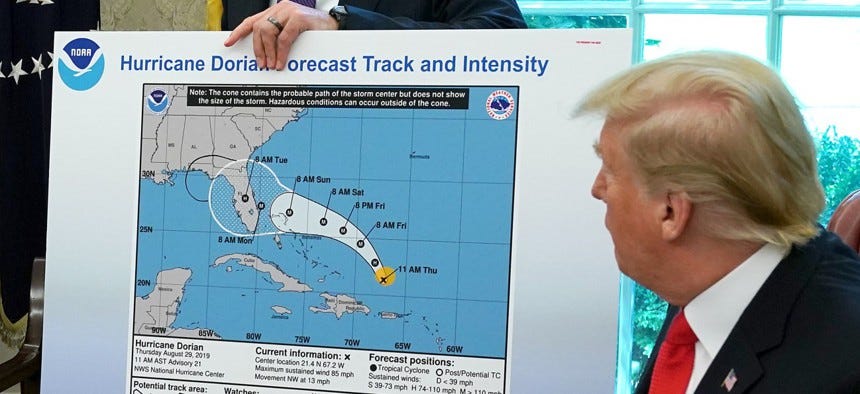
An independent investigation later concluded that Jacobs violated multiple scientific integrity policies, finding he acted “knowingly, intentionally and with reckless disregard” for agency standards.
For many in attendance, those memories have not faded.
“He’s putting the most positive spin he can,” said Diana Haemer, a doctoral student at Oxford University who attended the event.
Haemer said Jacobs appeared eager to project approachability before an audience of scientists and ocean advocates, but noted that his standing within much of the scientific community remains deeply damaged.
The presentation itself drifted between personal anecdotes and broad management philosophies. At times it felt less like a keynote address at one of the nation’s premier ocean conferences and more like a venture capital pitch for remaking a federal agency.
What was missing was perhaps more revealing than what was said.
On the second day of the Atlantic hurricane season, Jacobs offered little reassurance about NOAA’s readiness for the months ahead. There was no substantive discussion of climate change, despite oceans absorbing more than 90 percent of excess heat trapped by greenhouse gases. No mention of the global coral bleaching crisis now unfolding across much of the world’s reefs. No discussion of accelerating sea-level rise, collapsing marine ecosystems, or growing threats to protected ocean habitats.
The issues dominating scientific journals, policy debates, and coastal communities around the world were largely absent from the remarks.
Instead, the speech often seemed detached from both the audience and the moment.
That contrast was particularly noticeable because one of the conference’s strongest themes this year has been the inclusion of Indigenous voices. Tribal leaders and representatives from multiple Indigenous communities are participating throughout the week, bringing perspectives rooted in stewardship, cultural connection, and generations of lived experience with the ocean.
Yet Jacobs appeared oblivious to that context when he closed his remarks by describing the tarpon as his “ocean spirit animal.”
His reason, he explained, was that he enjoys catching and killing them.
The comment landed awkwardly in a room filled with ocean advocates, conservationists, researchers, and Indigenous representatives whose relationship with marine ecosystems is often framed around preservation rather than extraction.
Whether the remark was intended as humor or not, it underscored the broader disconnect that hovered over the morning.
Capitol Hill Ocean Week was founded to bring together scientists, policymakers, and advocates around the future of the world’s oceans.
On its opening day, however, science felt like an afterthought.
What happened at Capitol Hill Ocean Week was about more than one speech.
It was a snapshot of a broader transformation occurring across federal science agencies — a shift away from expertise, transparency, and public service toward privatization, branding, and political loyalty.
These stories rarely make national headlines until the consequences become impossible to ignore. By then, the damage has often already been done.
Mesoscale News exists to document these changes before they become tomorrow’s crisis. Paid subscriptions directly fund travel, records requests, data analysis, interviews, and the time required to produce independent investigative reporting free from corporate or political influence.
If this kind of journalism matters to you, please consider becoming a subscriber and helping support the next investigation.