
Florida approves ballot vote for eliminating property taxes
And it's not the total elimination DeSantis promised

Mesoscale News exists to follow the money, run the numbers, and tell you what politicians won’t.
If this kind of independent, data-driven reporting on Florida’s fiscal future matters to you, consider becoming a paid subscriber. Your support funds the research, public records work, and time it takes to expose the real consequences behind the headlines.
The Florida Legislature has advanced a radical constitutional amendment to the November ballot that would phase out most property taxes — making Florida the first state in modern U.S. history with neither a personal income tax nor broad property taxes.
Under House Joint Resolution 203, homesteads would gradually become exempt from all non-school property taxes, preserving only the revenue that funds K-12 education, but eliminating the tax base that currently pays for county and municipal services.
If voters approve the amendment, local governments would lose an estimated $14 billion every year.
That money currently funds the basics of civic life: police and fire departments, emergency response, public schools, libraries, water systems, road maintenance, and storm resilience. These are not abstract line items. They are the services people rely on.
Florida already operates near the bottom of the property-tax spectrum. Its effective property tax rate is lower than five of the nine states that already lack an income tax, and roughly middle-of-the-pack nationally.
Florida has already squeezed this revenue stream far more than most states. What’s left to cut isn’t waste — it’s core government.
Even before this proposal, Florida’s approach to public education was already under strain. According to the National Education Association’s most recent data, Florida ranks second-to-last in the nation for average teacher pay.
The current ballot language preserves school funding only to the extent it still collects property taxes for schools — but by eliminating the broader local tax base, it constricts municipalities’ ability to support essential services that interact directly with student well-being, such as policing around campuses, transportation safety, and emergency response.
The revenue at risk isn’t trivial. Local property taxes statewide currently generate tens of billions in annual revenue, the bulk of which supports not just schools, but police and fire departments, libraries, parks, waste management, and infrastructure maintenance.
Early legislative analyses estimate the statewide cost of eliminating non-school property taxes would exceed $10–$14 billion annually once fully phased in — and Miami-Dade alone would lose an estimated $3.27 billion this year.
Without replacement revenue, the fiscal void would force impossible choices:
Counties and cities could be pushed toward bankruptcy or dramatic cuts to services residents depend on.
The only remaining major tax lever is the sales tax—a highly regressive form of revenue that consumes a larger share of income from working families than from wealthier households.
Renters and those without homestead exemptions would see their share of the tax burden rise, potentially fueling housing cost pressures.
Florida is already upside-down on federal income, receiving $64 billion in transfers per year on average. That dependency on the federal government has been growing each year, making federal dollars more than a third of the state’s entire budget.
Florida’s budget has ballooned from $105 billion the year DeSantis was elected, to more than $150 billion in 2025. And every year except the pandemic, DeSantis has cut funding to education.
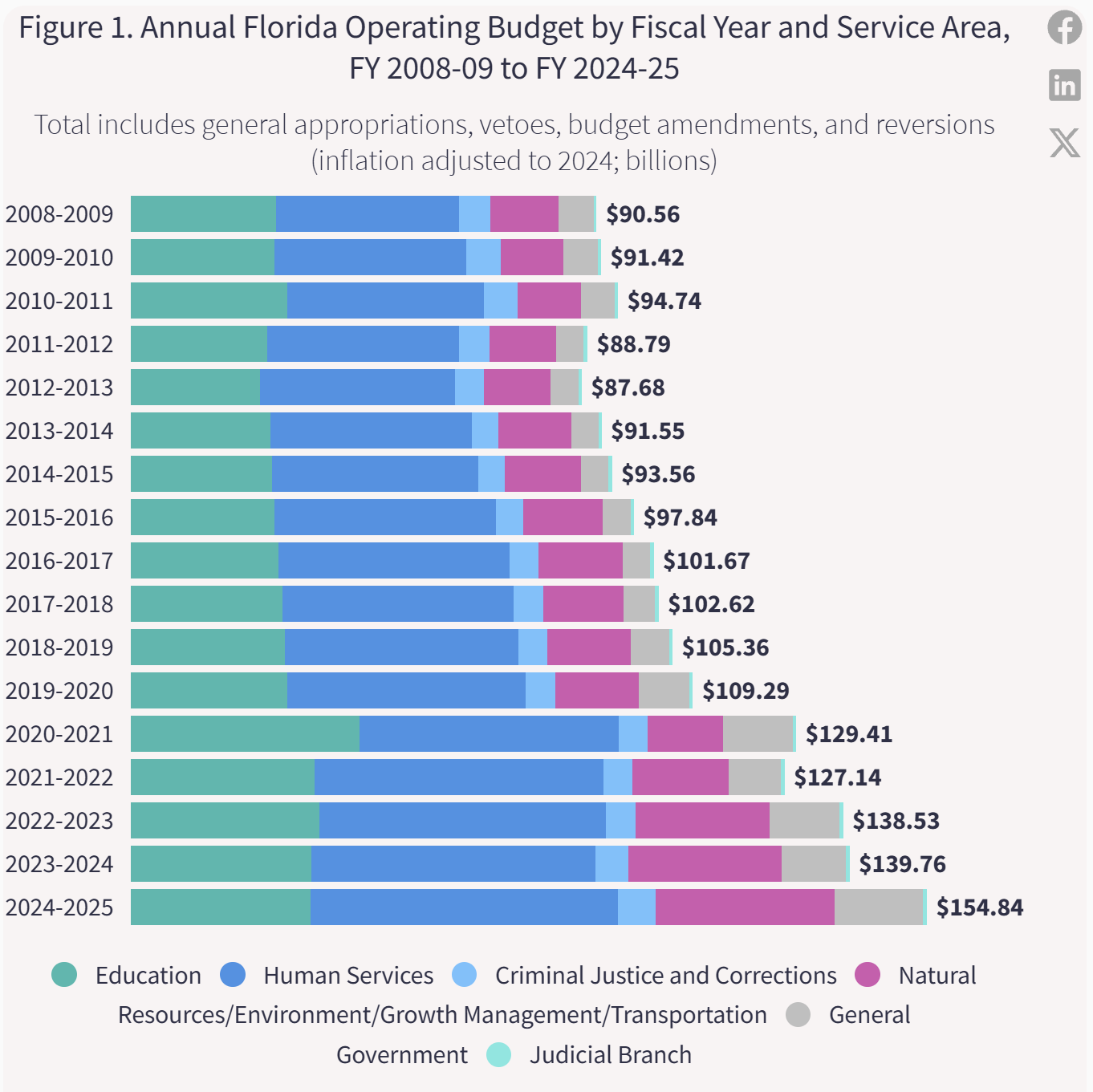
These short-falls cannot simply be made up. Florida will need a bailout — and they’ll expect taxpayers to do it via federal payments.
When DeSantis rushed the opening Alligator Auschwitz — a $573 million detention facility plagued with lawsuits over human rights abuses — he claimed the federal government would be using FEMA emergency funds to finance it. They haven’t, and the Trump regime has signaled that they don’t intend to.
DeSantis, despite the federal government stiffing the state, has pushed for the elimination of all property taxes, House leaders have modified the proposal to lock in minimum funding for law enforcement and public safety within the constitutional amendment’s text itself — a move aimed at placating concerns that cities would otherwise defund police and first responders.
Nevertheless, critics warn that such carve-outs do little to solve the core problem of a collapsing revenue base.
State and local Democrats have pointed out that even if schools are technically “exempt,” the erosion of local property tax collections will force districts to compete with counties and municipalities for shrinking general funds, worsening inequality between wealthy and poorer school systems. In Broward County, Democratic Rep. Robin Bartleman stated bluntly:
“Just doing the numbers, there are over 100 cities that after you do this will not even have enough money to maintain the local level of enforcement.”
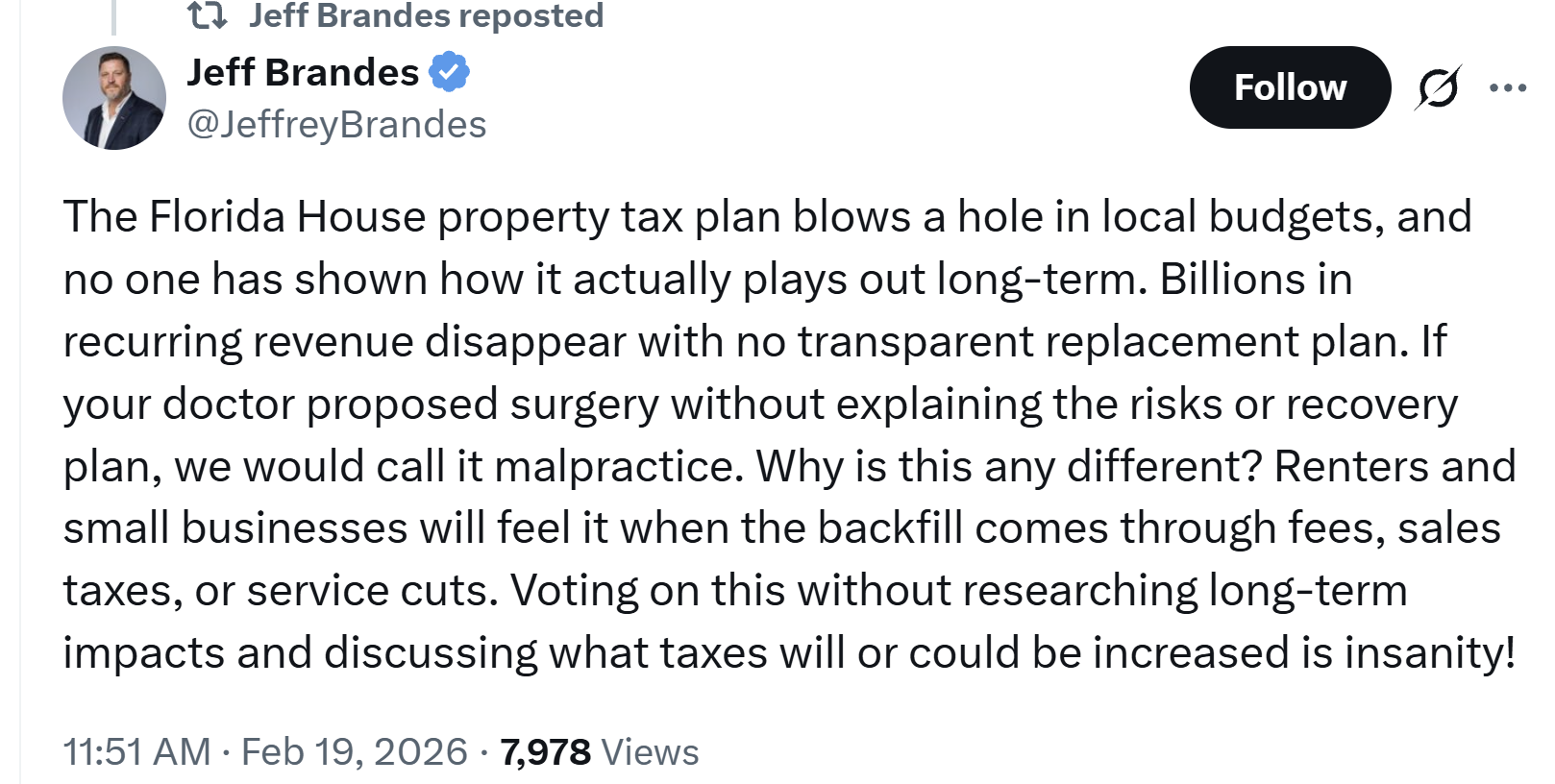
Even on the right, there’s unease about the political strategy. Republican former state senator Jeff Brandes argued that the amendment’s lack of serious planning leaves lawmakers exposed and voters uninformed:
“No research, no public plan. He was never going to produce his own plan and be attacked/criticized… When the flaws in the proposal get exposed, he will say it’s not ‘my plan’… it’s theirs.”
What is pitched as tax relief could end up shrinking local government to the point where public safety, infrastructure, schools, and community services are either defunded or supported by tax structures that shift burden onto the most economically vulnerable.
Unless lawmakers articulate a clear, equitable replacement revenue strategy — something that has not yet emerged — Florida risks entering the ballot with an amendment that trades short-term tax headlines for long-term fiscal instability.
Wow, thanks, Rebekah. I'm a Floridian and would have probably have voted for the DeSantis bill had I not read your column. DeSantis has a real lock on the state, but some of the counties declined to go along with his dictates. I live in Lee County, and they defied him on his non-Covid vaccination policy. Not only did I get my first shot, but gracious Lee County workers called me with a date and time for my second. Some of the elderly in line with me were actually crying with relief as they received their shots. It was a frightening time. I've read that the DeSantis anti-vaccination policy may have cost the lives of thousands of Floridians. Looks like the elimination of a portion of the property tax bill is DeSantis' farewell gift to his recalcitrant cities and counties.
I haven't lived in Florida for years, but when I did, I never felt the property taxes were outrageous...unlike Texas, which doesn't have income tax either, but has some really high property taxes. I wonder if any other state has a blueprint for how this could work? Poor rural Florida.