

Speaking out cost me my job, my safety, and years of my life. But it never changed my commitment to exposing wrongdoing and holding powerful institutions accountable.
Mesoscale News is how I continue that work — independently, without corporate influence or political interference. If you believe the truth is worth fighting for, please consider becoming a paid subscriber. Your support makes it possible for me to keep investigating, reporting, and telling the stories that powerful people would rather keep buried. From the West Bank in Palestine, to East Palestine, Ohio, you've trusted me to investigate, find, and report the truth.
I nearly lost my career and everything I've worked for because I refused to compromise public health data during a deadly pandemic.
I lost my privacy, my sense of security, and years of my life fighting a government with vastly more resources to defend itself than I had to defend the truth.
Six years later, I'm still fighting for justice.
Not because I didn't speak up. Not because my supervisors didn't know what I was reporting. But because, according to a Florida appeals court, I hadn't completed the paperwork before they fired me.
Now, another federal appeals court has ruled against a whistleblower who went to journalists before going through official channels.
Different cases. Different laws. Same devastating message: You can expose serious wrongdoing, risk everything, and still lose the protections intended for people who do exactly what you did.
Exposing corruption — but telling the wrong people first
In September, the U.S. Court of Appeals for the D.C. Circuit ruled against an anonymous whistleblower who exposed evidence of a foreign bribery scheme.
John Doe provided information to a journalist, who helped bring that evidence to federal investigators. The information led to an SEC enforcement action.
But Doe was denied an award under the Dodd-Frank whistleblower program because he didn't submit his information directly to the SEC before approaching the journalist.
In a 2–1 decision, the court concluded that his later submission hadn't contributed to the enforcement action, even though the court admitted the investigation started entirely because of the whistleblower's disclosure.
Here's a reality a lot of people don't consider: A lot of employees, especially younger employees, do not know the process for filing whistleblower complaints.
John Doe didn't -- it was an official at the SEC who urged the journalist to tell Doe to file a complaint.
I didn't know, either -- that's why I asked my boss for information about the process.
Most people don't consider that they might need to blow the whistle when they are hired, so they do not ask.
And each type of employment requires different processes - public vs private, federal vs state, sector, etc.
In SEC whistleblower complaints, the whistleblower is entitled to 10-30% of the financial penalty for penalties over $1 million.
In this case, the employer bribed foreign officials to secure business with state-owned entities, and the penalties exceeded $1 million.
At a minimum, the whistleblower is owed $100,000.
It's a major comfort when considering whether or not to lose your job and potentially be blacklisted for telling the truth.
Whistleblower attorney Stephen M. Kohn, chairman of the National Whistleblower Center, warned that the ruling would discourage whistleblowers from approaching journalists.
“Media whistleblowers are some of the most important whistleblowers we have,” Kohn told Whistleblower News.
“They have led to massive government recoveries and pushed investigators to focus on crucial instances of fraud,” Kohn continued. “The D.C. Circuit’s decision will disincentivize whistleblowers from going to the media, which in turn will actively harm investigatory efforts.”
A whistleblower exposes wrongdoing. Journalists investigate. Federal authorities take action. The government benefits.
But the person whose courage brought the misconduct to light can be denied an award because the information the whistleblower exposed reached investigators through journalism first.
Apparently, exposing wrongdoing isn't enough. You have to expose it in the correct order.
I told my boss. They fired me anyway.
From January through May 2020, I was managing Florida's COVID-19 public data systems and dashboard, a public health resource millions depended on during a deadly pandemic.
I was asked and refused to manipulate or suppress information Floridians needed to protect themselves and their families. When I had to comply, I made my objections known in writing to my boss.
I wasn't trying to become a whistleblower. I was trying to be a scientist.
Late Friday afternoon, I told my boss in writing that I was considering filing a whistleblower complaint concerning gross mismanagement and data manipulation with our public COVID-19 data systems and dashboard.
We met, I asked how to file the complaint, he advised me against it and told me to think about my family. He asked that I take time to think about it.
He knew what I was reporting. He immediately passed that information up the chain of command. By Friday evening, the Deputy Secretary ordered my termination during a flurry of emails and calls between my boss, his boss, her boss, and HR.
The following Monday morning, I was fired without cause.
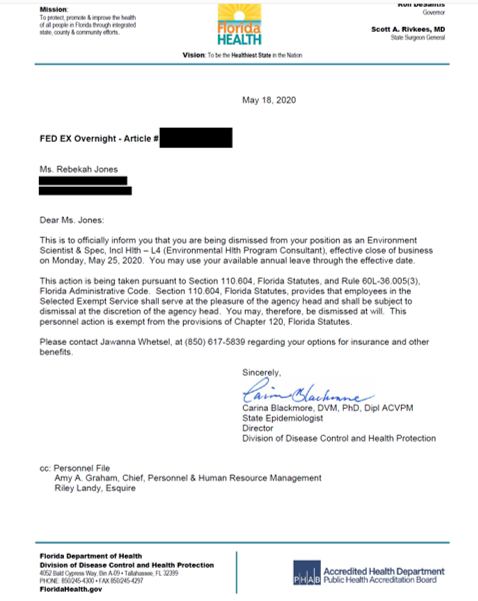
They fired me before I could complete the formal complaint process because they knew what I intended to expose.
In May 2021, a year later, Florida's Inspector General (IG) determined that my disclosures met the statutory criteria for whistleblower status.
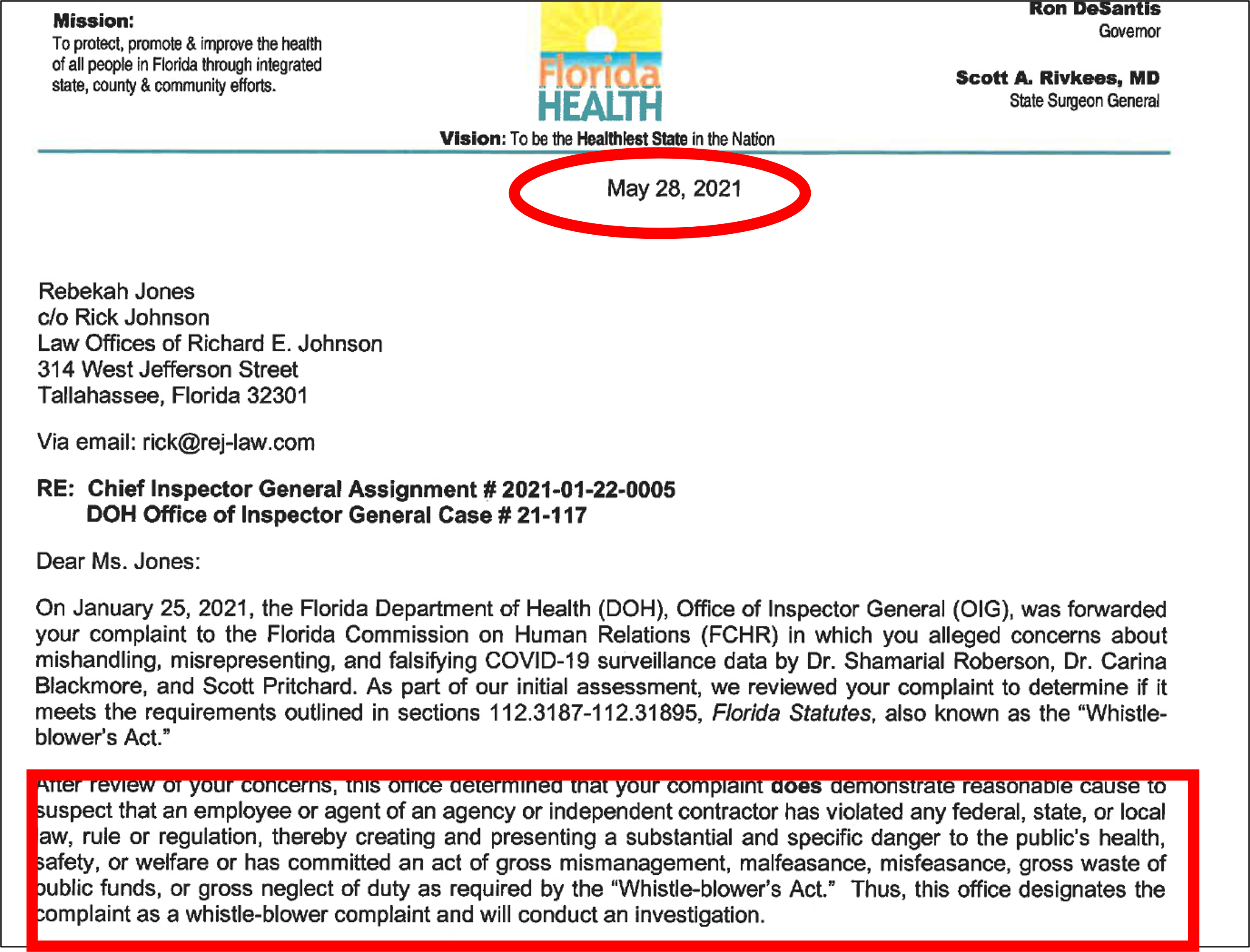
In July 2026, Florida's First District Court of Appeal upheld an earlier ruling claiming I could not have been fired for whistleblowing since I had not filed the formal complaint yet.
The appellate court explicitly stated it did not consider the merits of my case, only that firing me knowing I was filing a complaint was allowable under the statute. We've appealed that ruling, and that appeal is pending.
Florida has since changed its whistleblower laws to require a formal, signed, written complaint submitted directly to the agency's Inspector General office or other oversight agency.
(They've changed a number of laws because I fought the state in court and won.)
Here's what should frighten every public employee in Florida about that:
Today, the state's private-sector whistleblower law expressly protects employees who disclose or threaten to disclose wrongdoing. Its public-sector law doesn't extend the same protection to threatened or impending disclosures.
The employer knows what's coming. The employee has sounded the alarm. And the law can still leave the employee exposed.
Unlike SEC whistleblowers, public employees in Florida aren't entitled to any awards for risking their jobs and safety by coming forward.
The risk they take is enourmous; my life over the past 6.5 years has proven that.
Now the state is saying they won't protect people who witness law breaking or policy violations if they do not first get an attorney and file a formal, written, signed complaint to the right agency.
It's called pre-emptive retaliation, and it's when an employer taking adverse action (firing, demoting/reassignment, suspending, etc) an employee because the employer believes the employee intends to file a complaint, report misconduct, or engage in legally protected whistleblowing, even though the employee has not yet done so.
Florida just ruled against that protection.
“The Legislature could have included language providing a cause of action for a threatened or anticipated disclosure, but it did not,” the ruling stated.
When I made my disclosures, the statute did not require a formal complaint with any specific agency.
The statute at the time only required three critera:
That I made a disclosure qualifying under the law (IG office established I did)
To a superior (my boss)
In writing (text and email)
It did not require any defined level of detail, any specific agencies, or any specific means other than in writing.
The legislature should have included that language before I blew the whistle. The state cannot change the law and use it retroactively.
The cost doesn't end when the headlines fade
People love celebrating whistleblowers when they first come out.
They give speeches about courage, praise integrity, and talk about speaking truth to power.
But there's a period between telling the truth and reparations (for the few who ever get it) for it that rarely makes it into those speeches.
That's where your life gets dismantled.
Your career disappears. Your reputation becomes a target. Your financial stability evaporates. Your children learn what it means to be afraid because of the work you do.
In December 2020, armed police raided my home. My children were there. The single criminal charge stemming from that raid was dismissed two years later.
But dismissing a charge doesn't erase the trauma. It doesn't restore your children's sense of safety or return the years spent fighting to survive.
I've spent six years trying to explain that whistleblowing isn't an abstract legal argument.
It's a human being making an impossible calculation: How much of my life am I willing to lose to prevent someone else from being harmed?
Nobody should have to make that choice.
The law can change. Here's where to start.
The SEC case concerns financial awards. Mine concerns retaliation under Florida's public-sector law. But both expose how procedural requirements can leave whistleblowers vulnerable.
In one case, a whistleblower went to the press before the agency. In mine, I went to my supervisor before completing the formal complaint process.
One was too early to the public. The other was too late to the paperwork.
We cannot keep treating these failures as inevitable.
Congress is considering the bipartisan "AI Whistleblower Protection Act (S. 1792 / H.R. 3460),” which would protect workers reporting dangerous AI vulnerabilities and violations, including threats to public health and safety. The legislation would provide remedies for retaliation, including reinstatement and financial compensation.
It's a meaningful opportunity to address gaps in protections for workers who identify emerging technological dangers. But those protections must also be strong enough to work when employers retaliate.
Here's how you can help:
- Contact your Senators and House representative to ask about their position on the AI Whistleblower Protection Act and stronger protections against preemptive retaliation.
Visit the National Whistleblower Center's AI protection campaign to review the legislation, sign its petition, or send a message to Congress.
Ask your state lawmakers whether public employees are protected when their agency suspects their intention to report wrongdoing before an employer can fire them.
Nobody should have to pay this price.
I didn't become a whistleblower because I wanted attention or a political fight.
I became one because I couldn't live with the possibility that my silence would cost thousands of lives.
I still believe I made the right decision.
But believing that doesn't give me those years back or erase what my family endured.
When doing the right thing becomes more dangerous than doing the wrong thing, the law needs to change.
Because the greatest danger isn't only what happens to people like John Doe or me.
It's what happens when the next scientist, accountant, engineer, nurse, or public servant sees what happened to us and decides they can't afford to speak up.
It's the poisoned water nobody reports. The falsified records nobody exposes. The public health data nobody challenges.
It's every warning the public never receives because someone who knew the truth was too afraid to tell it.