

Author Note:
I recently returned from the West Bank, Palestine where I was one of eight American delegates visiting the region. Our group included myself, my friend Aalia Mauro, former Congresswoman Cori Bush, her husband, and several others. I recently discussed some of what happened with THE LEFT HOOK with Wajahat Ali. You can watch that interview here.
I will be publishing video, audio, and analysis from that trip over the coming weeks. Please be patient as I have over 60 GB of zipped video to review. To support my work, please subscribe below or donate here.
They Came for Mustafa Zaatar in the Middle of the Night
Mustafa Zaatar was still shaken when we met him.
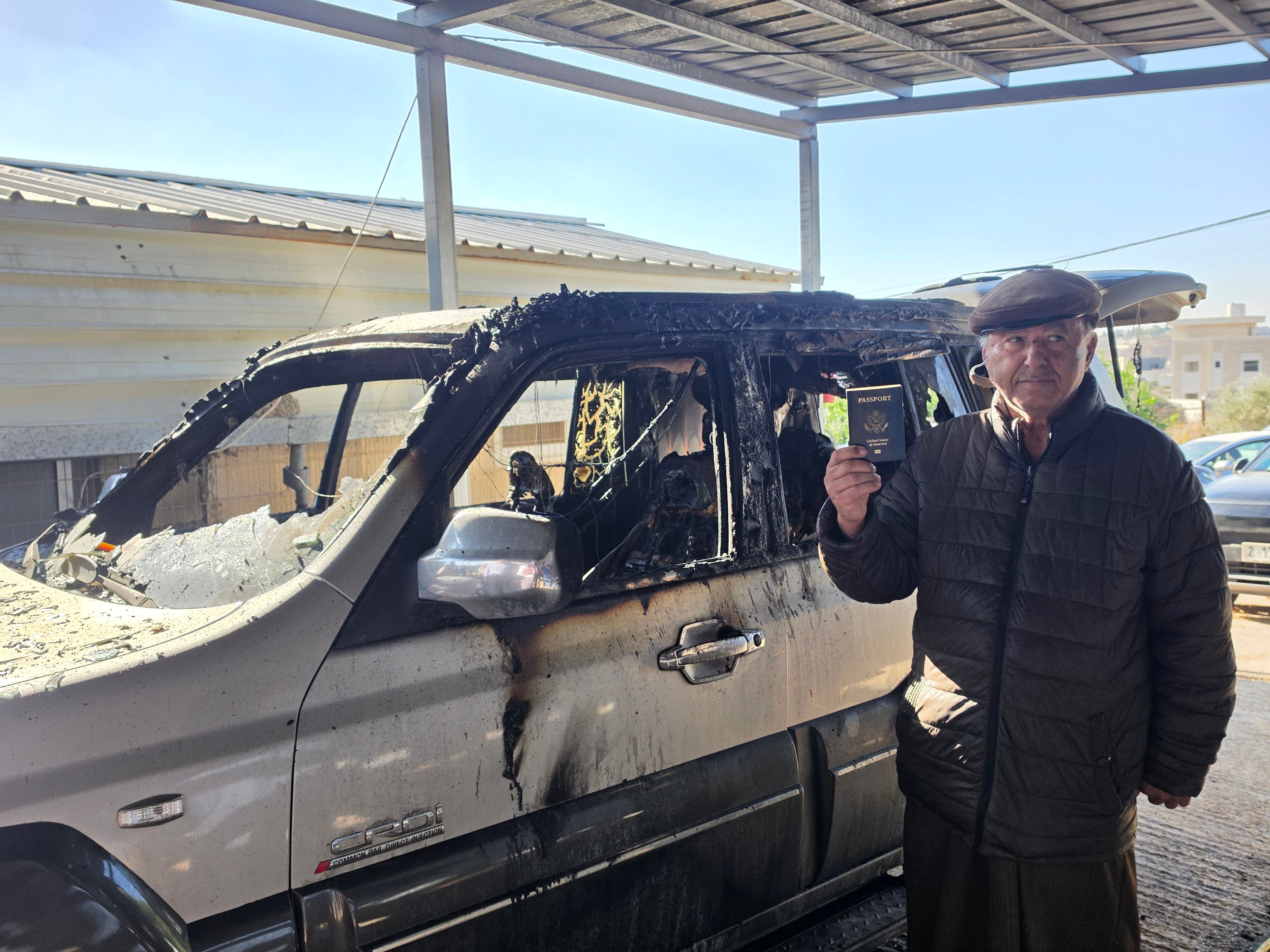
The Palestinian American, 78, sat with our delegation less than eight hours after the attack, and described what it was like to watch a mob descend on his home and land. The attack was over, but it clearly had not left him.
His fields had been burned. Cars torched. His tractor damaged. Windows smashed. Mustafa told us roughly 150 Israeli attackers had descended on his property. He described waiting for help while the destruction continued around him.
This was his home.


Mustafa has been an American citizen since 1976. He had spent decades building a life that stretched between the United States and Palestine, only to find himself sitting before a group of visiting Americans trying to explain what it feels like to be terrorized on your own land, and to wonder whether the country whose passport you carry is willing to protect you.
There is something particularly cruel about violence against a home. A home is supposed to be the place where fear stops at the door. Burn the fields around it, smash its windows, torch the cars outside, and the message is difficult to misunderstand:
You are not safe here.
At about 1:30 in the morning on September 27, Israeli attackers entered Abu Falah, east of Ramallah. Mustafa was asleep inside his home.
Soon, everything outside was burning.
Three vehicles were set on fire. Mustafa rushed to shut the doors as he and his wife tried to understand what was happening outside. Footage taken afterward documented the burned vehicles. Mustafa separately told Anadolu that dozens of armed Israelis had surrounded his home and vandalized the property.
Neighbors eventually confronted the attackers and helped extinguish the fires.
Imagine being 78 years old, inside your own home in the middle of the night, watching your property burn.
Now imagine carrying an American passport and wondering whether it means anything at all.
“I am an American citizen,” Mustafa said afterward, “but I have not felt that it protected me or offered me anything.”
His relatives in the United States contacted American consular officials. Mustafa asked American officials to come see what had been done to his home.
But there is something Americans need to understand about what is happening in the West Bank: the violence cannot be separated from the land.
That became impossible for me to ignore while traveling there.
We met Palestinians who described being afraid to reach their own agricultural land. We traveled roads whose accessibility depended on who was trying to use them. We encountered gates and closures capable of turning a short trip between neighboring communities into a long detour — or preventing it altogether. We stood overlooking agricultural land that residents told us they could no longer safely reach.
And we met people like Mustafa.
A family frightened out of its home loses more than a building. A farmer who cannot safely reach his olive trees loses more than a harvest. Close a gate. Block a road. Threaten a family. Burn a field. Destroy a tractor. Make the journey to someone’s own land dangerous enough, often enough, and eventually geography itself begins to change.
Fear becomes a border. Violence becomes a land-use policy.
The question goes beyond who formally owns a piece of land and becomes: who can actually reach it, live on it, farm it, travel across it and return safely home?
That is why what happened to Mustafa cannot be treated as another isolated act of violence. And it is why legislation introduced in Congress just days after this latest attack matters.
Reps. Joaquin Castro, Madeleine Dean, Don Beyer, Greg Casar, Sara Jacobs, Veronica Escobar and other House Democrats introduced the Stop the Settlements Act, legislation aimed at the continued establishment and expansion of Israeli settlements and outposts.
The bill would require sanctions against foreign individuals and entities involved in establishing or expanding settlements and outposts in the occupied West Bank and would prohibit imports into the United States of goods produced in those settlements and outposts.
Whatever happens to the bill in Congress, its premise addresses something that becomes painfully obvious once you stand on the land yourself: violence, movement, and territorial control are intertwined.
Mustafa understands that better than most.
He has watched people come for his land. He has watched his property burn. He has watched American citizenship fail to keep violence from reaching his front door.
And still, at 78 years old, he refuses to be frightened away.
“They are trying to force us off our land,” Mustafa said after the latest attack. “We will stay here. We will not leave.”
That sentence stayed with me.
Because our delegation eventually packed our bags. We crossed checkpoints. We boarded planes.
We left Palestine and came home.
That’s not possible for many Americans in the West Bank.
At least nine Americans have been killed in the West Bank since 2022 in incidents involving Israeli security forces or Israeli attackers, according to a Senate resolution introduced this year seeking answers about their deaths. That Senate resolution failed 47-53 on the day I returned home.
Palestinian Americans like Mustafa are still alive to tell us what is happening to them, but how many times should they have to?
Mustafa should not have to watch another car burn. He should not have to wonder whether armed men will return in the middle of another night. He should not have to prove, again and again, that an American citizen deserves protection simply because that American is Palestinian.
His home is still there.
His land is still there.
His olive trees are still there.
And Mustafa is still there.
At 78 years old, after everything that has already happened, he refuses to surrender the place he calls home.
The question now belongs to every one of our representatives in Congress:
What is an American passport worth when the American holding it is Palestinian?
Notes:
License information: Photos and videos included in this story may be shared with included credit to Rebekah Jones, Mesoscale News.
The subtitles are auto-generated from Substack and may include misspellings.
Permanent occupation of lands seized by force is a war crime. The so-called "settlers" are perpetuating this ongoing crime by their mere presence, to say nothing of their violent actions (those committing violence to drive Palestinians off their land are terrorists by any definition of the word).
Also, I dearly wish news organizations would stop lending an air of legitimacy to their actions by referring to these people as "settlers" without using qualifiers such as "so-called": you can't "settle" land that is already settled.