
All seven women selected for promotion by military boards were removed. No white men were.

For the first time in nearly two decades, there are no active-duty women serving as four-star generals or admirals in the United States military in 2026.
The milestone comes after Defense Secretary Pete Hegseth intervened in a series of military promotion decisions that disproportionately affected women and minority officers.
Military promotion boards selected 31 officers for advancement after determining they were the most qualified candidates within their respective competitive categories.
Hegseth ultimately canceled or withdrew nine promotions.
All seven women selected by the boards were removed.
The only other officers denied promotion were two Black men.
No white men selected by the boards were removed.
The military’s promotion boards are designed to identify the most qualified officers for advancement based on performance, command experience, evaluations, and service records.
Their recommendations are traditionally given significant weight because they are intended to reduce political influence over promotions.
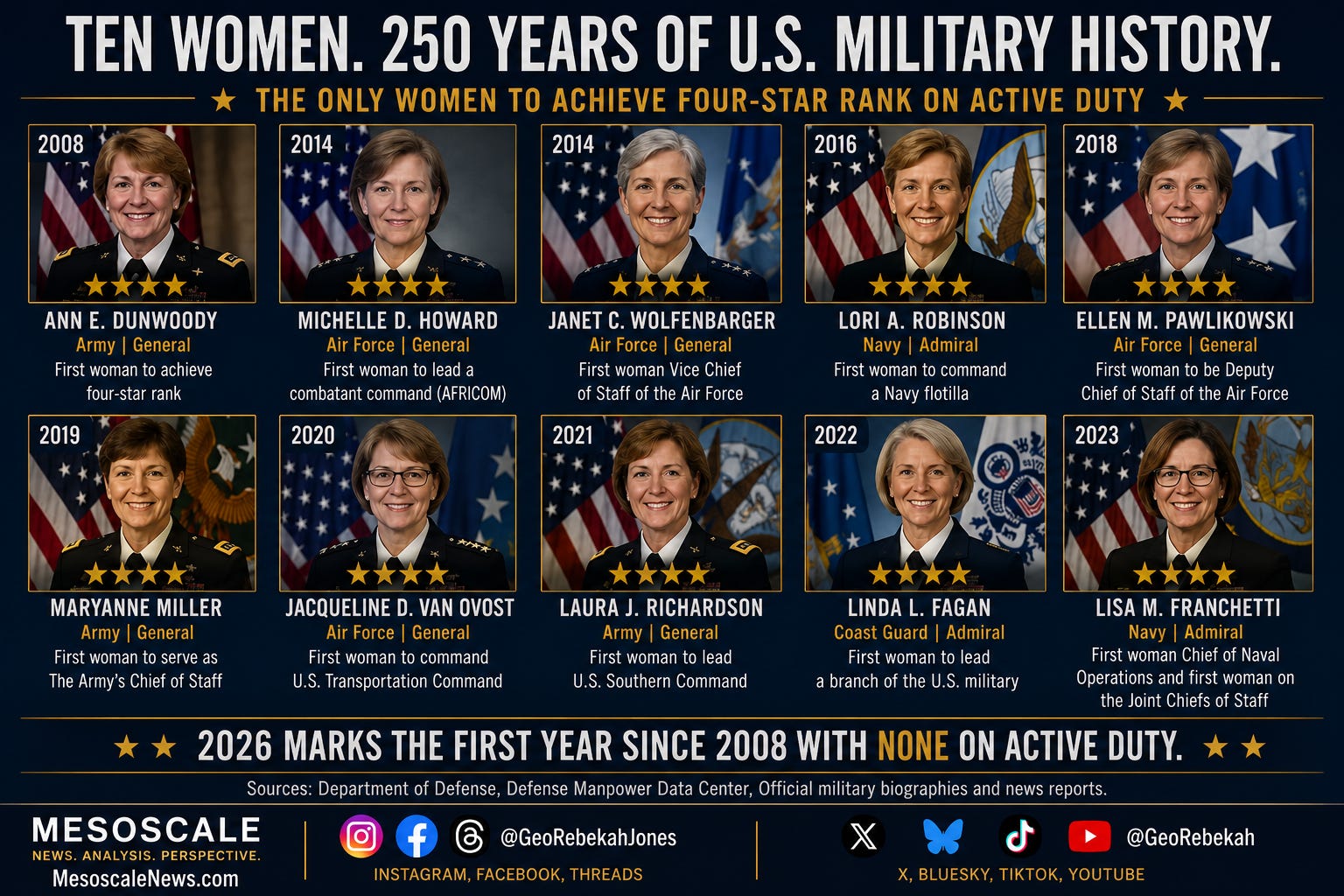
Hegseth’s targeted attacks on women in the U.S. military has left the armed forces with zero four star female generals for the first time since 2008. With zero left on the list to be promoted, that likely won’t be a problem fixed in the near future.
A Brief History of Female Four-Star Officers
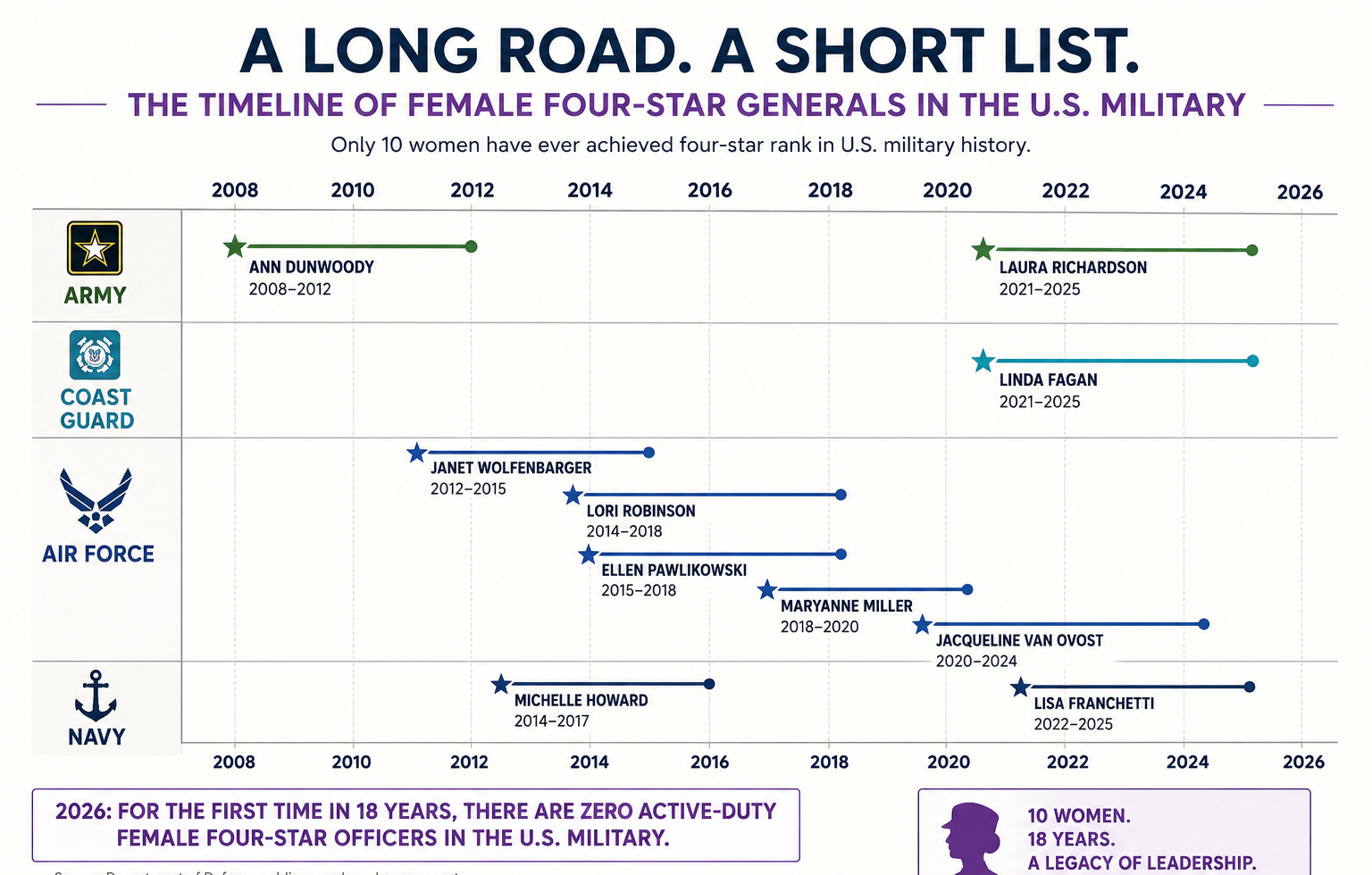
Only ten women have ever achieved four-star rank in U.S. military history.
Army
Ann Dunwoody (2008–2012)
Laura Richardson (2021–2025)
Coast Guard
Linda Fagan (2021–2025)
Air Force
Janet Wolfenbarger (2012–2015)
Lori Robinson (2014–2018)
Ellen Pawlikowski (2015–2018)
Maryanne Miller (2018–2020)
Jacqueline Van Ovost (2020–2024)
Navy
Michelle Howard (2014–2017)
Lisa Franchetti (2022–2025)
Dunwoody became the first woman in U.S. history to receive a fourth star in 2008. Over the following 17 years, women steadily advanced into the military’s highest leadership positions, including combatant commands, major logistics operations, fleet commands, and service chief roles.
That progression has now ended.
Hegseth’s History of Opposition to Women in Leadership
Hegseth’s nomination as Secretary of Defense was controversial in part because of public allegations regarding his treatment of women.
Hegseth’s own mother described him as an “abuser of women.”
Hegseth was flagged as a potential “insider threat” before President Biden’s 2021 inauguration. Internal correspondence showed concerns raised by a superior officer that ultimately resulted in him being removed from National Guard duties connected to the inauguration.
Since becoming Secretary of Defense, Hegseth has been on a war path to reduce the role of women and minorities within the military hierarchy.
In his 18 months since being confirmed as US Secretary of Defense in a 51-50 vote (a tie broken by Vice President JD Vance), Hegseth has:
Stated that women should not serve in combat roles and erroneously claimed their inclusion made the military less effective.
Fired Admiral Lisa Franchetti, the first woman to lead the Navy and first woman to serve on the Joint Chiefs of Staff.
Fired Admiral Linda Fagan, the first woman to lead a U.S. military branch.
Female Navy officers told the Associated Press they viewed the removal of all women from a promotion list as a signal that their careers now have a ceiling.
Part of a Broader Shift
The promotion decisions align with broader personnel changes across the federal government under the Trump administration.
Project 2025, the “blueprint” for dismantling democracy developed by the ultra-far-right Heritage Foundation and allied organizations, calls for eliminating many diversity and inclusion initiatives throughout the federal government.
These discriminatory practices disproportionately harm women and minorities.
Through executive orders, agency directives, and personnel actions, departments have been instructed to eliminate DEI offices, terminate related programs, remove diversity requirements from hiring and training, and review employees associated with those initiatives.
Diversity initiatives do not change educational requirements, military standards, professional credentials, or performance benchmarks.
Rather, they are intended to expand recruitment pipelines, identify barriers to advancement, and ensure qualified candidates are not excluded because of discrimination or unequal access to opportunity.
Researchers have warned that eliminating programs designed to reduce barriers to advancement may allow existing disparities in hiring, promotion, retention, and leadership representation to persist or widen, particularly in institutions with documented histories of discrimination or unequal access to opportunity.
DOGE eliminated at least $3 billion in grants supporting research, education, workforce development, and public programs benefiting women and girls.
Subsequent investigations and court proceedings uncovered evidence that DOGE-led funding decisions explicitly considered protected characteristics.
In May 2026, U.S. District Judge Colleen McMahon ruled that DOGE’s cancellation of more than $100 million in National Endowment for the Humanities grants was unlawful and discriminatory, finding that DOGE had “blatantly used protected characteristics as criteria for grant termination.”
Court records showed DOGE used ChatGPT in a way that was both “illegal and dumb” to target grants with keywords about race, gender, ethnicity, religion, and other protected categories.
The judge further found that DOGE’s process resulted in the termination of grants involving subjects including Black Americans, women, Jews, Indigenous communities, and other historically underrepresented groups, concluding that the government had engaged in unconstitutional discrimination and viewpoint-based decision-making.
And in the military, the administration has removed several of the most senior women serving in military leadership, and is denying all female candidates for promotion.
Whether that is a temporary anomaly or the beginning of a broader trend remains to be seen.
What is not in dispute is the historical significance of the moment.
The disappearance of women from the military's highest ranks should concern every American. If you value journalism that follows the facts wherever they lead, please consider supporting Mesoscale with a paid subscription.
Blatant misogny served on a roll of racial prejudice. But that's just what his enablers ordered.