
A wrongfully convicted man won an election. The state eliminated his office. Then Louisiana's attorney general was indicted, the governor promised a pardon, and the state's highest court intervened.

A state attorney general has been indicted for threatening public officials, the governor has vowed to protect her, and Louisiana is now staring into the abyss of a constitutional crisis."
While the sparsely-attended July 4 fireworks topped off a failed 16-day “American fair” in Washington, DC, a constitutional crisis was unfolding in Louisiana.
Louisiana crossed into territory that few Americans alive have ever witnessed inside the United States — and it began with the election of an exonerated man.
Calvin Duncan spent nearly thirty years in prison for a murder he did not commit. An armed robbery in the Treme left a 23-year-old man dead and his 15-year-old white girlfriend as the only witness. The police had no leads, and targeted Duncan after Duncan’s ex-girlfriend called in a tip. Duncan was held without trial for three years. His trial lasted one day, despite no evidence connecting him to the case, and he was found guilty of first-degree murder and sentenced to life without parole.
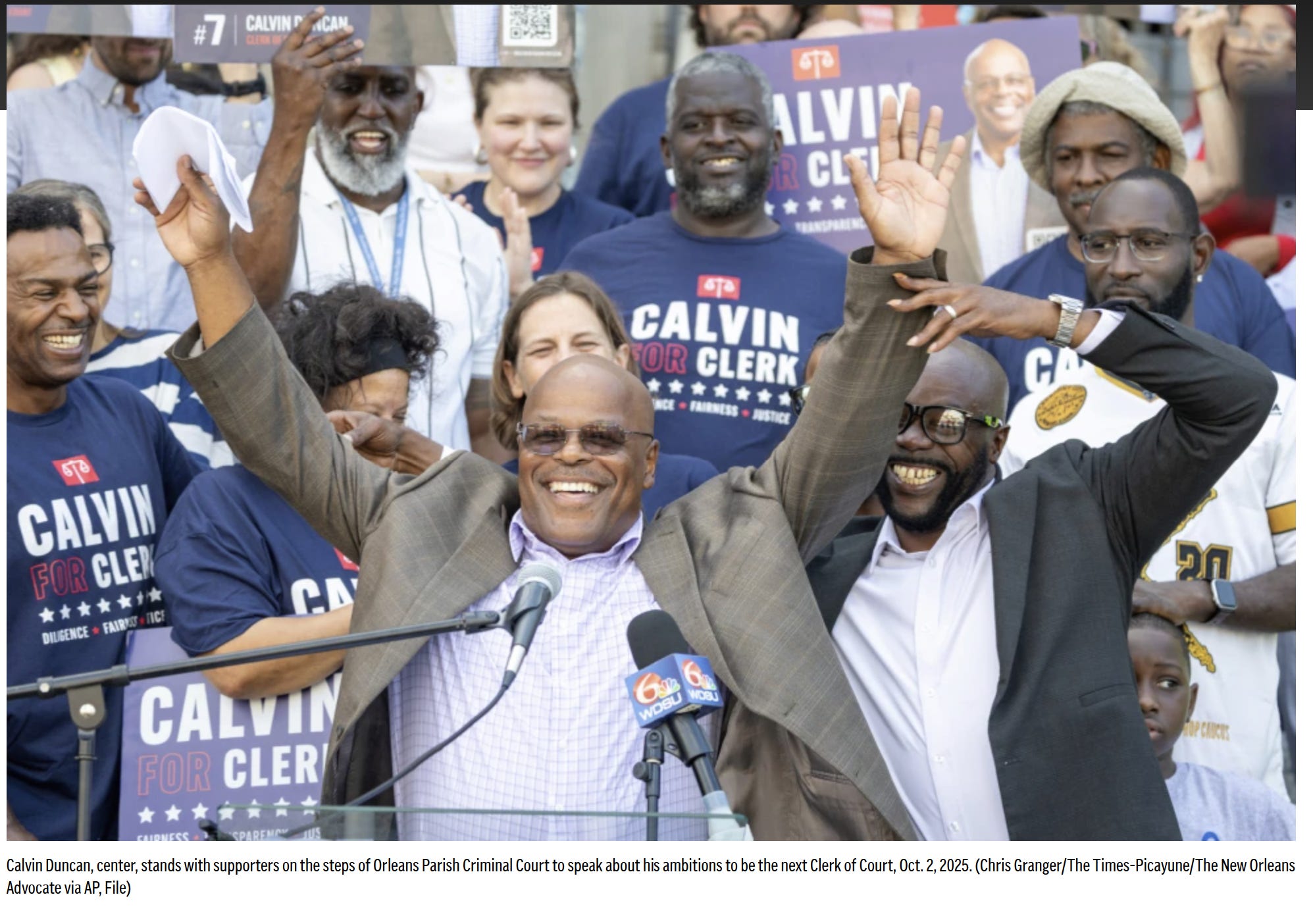
Duncan spent three decades behind bars at Angola — one of the most notoriously violent prisons in the country, named after one of the most horrific slave plantations in American history.
During his sentence, Duncan became a jailhouse lawyer, helping countless incarcerated people challenge wrongful convictions and navigate a legal system that had failed them just as profoundly as it had failed him. After winning his own freedom, he became one of Louisiana’s most respected criminal justice reform advocates.
Last November, voters in New Orleans elected Duncan Clerk of Criminal District Court with 68 percent of the vote.
The symbolism was impossible to miss. A Black man whose life had been stolen by Louisiana’s criminal justice system had been entrusted by voters to help reform that very system.
Then Louisiana’s Republican-controlled government intervened.
Just days before Duncan was set to take office, state lawmakers passed legislation eliminating the very office he had won. Governor Jeff Landry signed it.
Supporters claimed the move as government efficiency and court consolidation. Critics recognized what really happened: the state nullifying an election because it disliked the person voters had chosen.
Had this happened in another country, Americans would have had little trouble recognizing what they were witnessing.
The fight over Duncan’s election quickly became about more than one office. Federal judges temporarily blocked the law. Appeals courts reinstated it. Duncan was sworn into office, only to lose the position hours later. The Louisiana Supreme Court ultimately upheld the legislature’s action in a sharply divided 4-3 decision. Dissenting justices warned that the ruling undermined both democratic accountability and the rights of voters.
New Orleans officials continued seeking avenues to preserve the will of the voters. In response, Louisiana Attorney General Liz Murrill threatened city officials with removal from office and other consequences if they continued opposing the state’s restructuring of New Orleans courts. Among those targeted were New Orleans Mayor Helena Moreno and Orleans Parish District Attorney Jason Williams.
Last week, a New Orleans grand jury indicted Murrill on 16 felony counts, including public intimidation and malfeasance in office.
The charges alone would have been extraordinary.
What happened next was unprecedented.
A judge issued an arrest warrant and set bond at $400,000. Murrill falsely claimed the indictment was unconstitutional and retaliatory. Governor Jeff Landry immediately promised to pardon her if she were convicted. The Republican Attorneys General Association rallied to her defense. Less than twenty-four hours later, the Louisiana Supreme Court issued an emergency stay of the criminal proceedings.
But for a brief and remarkable period of time, Louisiana entered constitutional territory that no modern American state has experienced in living memory.
Despite the Supreme Court’s initial stay, Murrill’s arrest warrant reportedly remained active in law enforcement databases through the July 4 holiday. News organizations across Louisiana reported confusion among officials and law enforcement agencies over whether the state’s chief law enforcement officer could herself be arrested.
Late on the evening of July 4, the Louisiana Supreme Court issued an extraordinary clarifying order directing that the warrant be recalled and removed from all law enforcement databases.
The court’s dissenting justices responded with language rarely seen in modern American jurisprudence.
Chief Justice John Weimer warned that “no one is above the law and all stand equal before a court of justice.” Justice John Guidry criticized what he described as an unprecedented preferential intervention for a politically powerful defendant.
It is difficult to overstate how extraordinary this sequence of events was.
A grand jury indicted the state’s highest law enforcement officer. An arrest warrant was issued. The governor promised a pardon before any trial had occurred. The state’s highest court intervened on an emergency basis. Dissenting justices accused their colleagues of granting special treatment. And for a brief moment, Louisiana appeared to be approaching the kind of institutional confrontation Americans usually associate with constitutional crises in other countries.
The immediate confrontation may have been avoided.
The underlying crisis has not.
Because constitutional crises do not begin when politicians break norms.
Politicians break norms all the time.
Constitutional crises begin when institutions stop agreeing on who has the authority to enforce those norms.
History offers very few reassuring examples.
In 1957, President Dwight Eisenhower federalized the Arkansas National Guard after Governor Orval Faubus used state authority to resist federal court orders requiring school integration in Little Rock. In 1962, federal marshals and troops were deployed to Mississippi after state officials attempted to block James Meredith from enrolling at the University of Mississippi.
In both cases, competing institutions claimed legal legitimacy.
In both cases, the crisis was ultimately resolved because a higher authority existed that all parties, however reluctantly, recognized.
More recently, similar questions have emerged internationally.
The International Criminal Court’s arrest warrants for Israeli officials forced governments around the world to confront an uncomfortable question: if legal authorities issue an arrest warrant and political authorities oppose it, who prevails?
New York Mayor Zohran Mamdani’s pledge to honor international legal obligations if required reflects the same underlying dilemma Louisiana briefly confronted this week.
The particulars are different.
The question is the same.
Who gets to decide when the law applies?
That is where Louisiana now finds itself.
A wrongfully convicted Black man won an election to reform the system that stole thirty years of his life. The office he won was eliminated. State officials allegedly threatened local leaders who attempted to preserve the will of the voters. A sitting attorney general was indicted. The governor promised protection before any trial could occur. The state’s highest court intervened.
And somewhere beyond the court filings, the press conferences, the emergency orders, and the partisan talking points sits a far more profound question.
If Americans can no longer agree that no person is above the law, that elections matter even when we dislike the outcome, and that government officials are bound by the same rules as everyone else, then what exactly remains of the democracy we believe we are defending?
History offers an unsettling answer.
Democracies do not collapse because a single law is broken or because a single election is stolen. They collapse when enough people with power decide that the law itself is conditional — that it applies to their opponents, but not to themselves; that elections matter only when they produce acceptable outcomes; that courts deserve respect only when they rule the right way; and that power, rather than legitimacy, is what ultimately determines who governs.
When democracies reach the point where institutions no longer agree on who has the legitimate authority to enforce the law, the constitutional crisis is not coming.
It has already begun.